
High-Protein Roti Recipe: 17g Protein + Vegetarian Protein Guide
Sep 10, 2026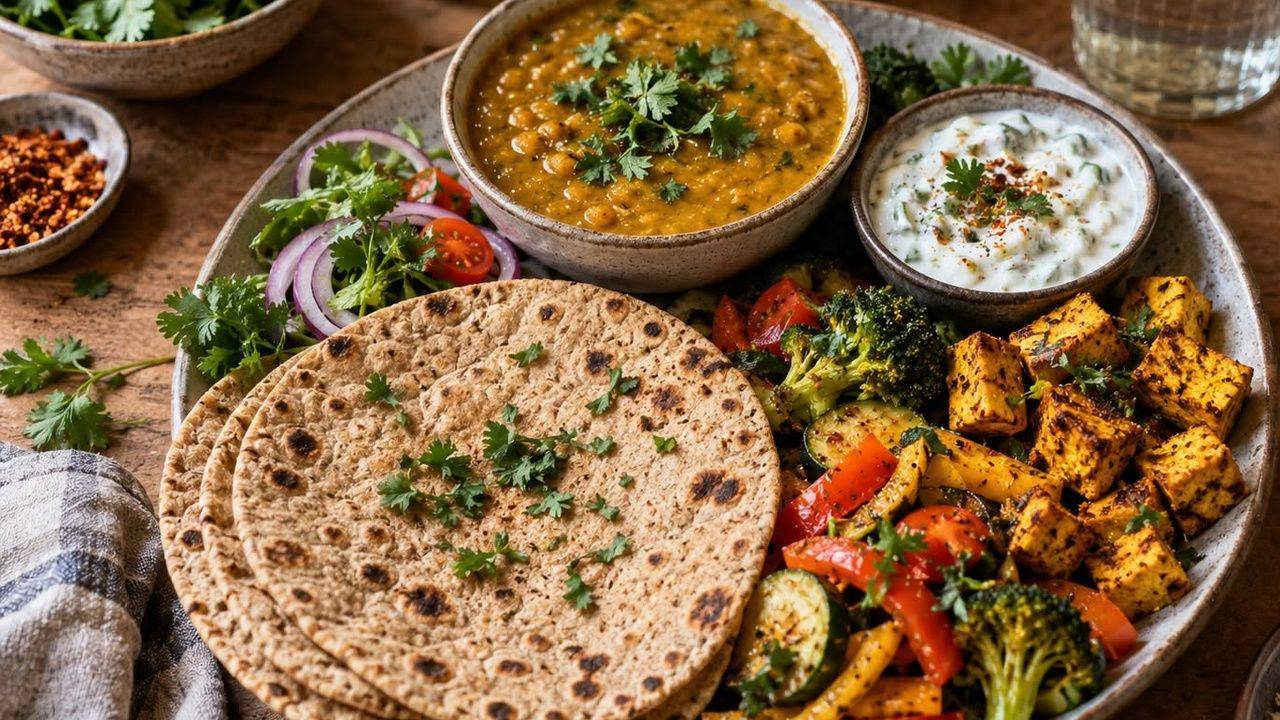
The Outsiders High-Protein Roti: Ten Years Later
How to Make High-Protein Rotis and Build a Better Vegetarian Protein Meal
Ten years ago, in the original Outsiders Kitchen, we decided to experiment with something.
Roti.
Not because there was anything wrong with traditional roti.
Quite the opposite.
Roti is one of the simplest foods in the world:
flour, water, heat.
But we had a question:
Could we preserve the simplicity and usefulness of rotis while dramatically increasing its protein content?
So, in 2016, two self-proclaimed high-protein roti scientists went to work.
The original Facebook post began appropriately:
“Oooooooooohhhhhhh SNAP!!! Found myself in the midst of two high protein roti scientists!”
What came out of the kitchen was remarkably simple.
The Original Outsiders High-Protein Roti Recipe
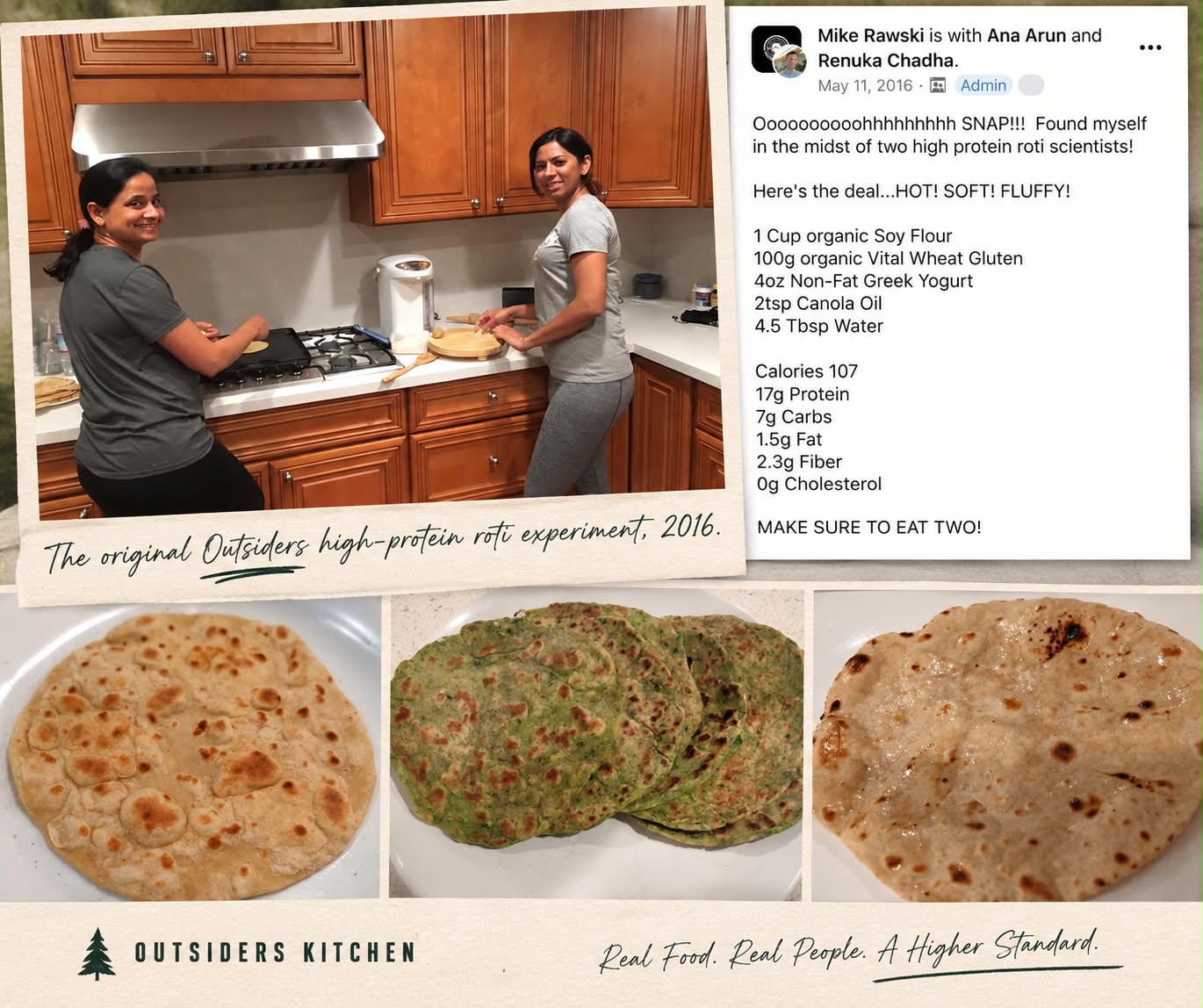
Ingredients
-
1 cup organic soy flour
-
100 grams organic vital wheat gluten
-
4 ounces nonfat Greek yogurt
-
2 teaspoons canola oil
-
Approximately 4½ tablespoons water
According to our original calculations, each roti provided approximately:
-
107 calories
-
17 grams protein
-
7 grams carbohydrate
-
1.5 grams fat
-
2.3 grams fiber
At the time, we were primarily trying to solve one problem:
How do we put more protein into a food people already enjoy eating?
Ten years later, we understand that there is an even more interesting question.
How do we build the entire meal so that the protein we consume provides the amino acids our bodies actually need?
Because when it comes to protein, grams are only part of the story.
Protein Is More Than a Number
When someone sees 17 grams of protein, it is tempting to assume that 17 grams of one protein is nutritionally identical to 17 grams of another.
It isn’t quite that simple.
Proteins are made from amino acids.
Nine amino acids are considered essential because the human body cannot synthesize enough of them to meet its needs.
They therefore need to come from the diet.
Different foods provide these essential amino acids in different proportions.
They also differ in digestibility.
This means two foods containing the same number of grams of protein can provide different amounts and proportions of digestible essential amino acids.
This is one reason modern protein-quality research uses measures such as the Digestible Indispensable Amino Acid Score, or DIAAS, rather than looking exclusively at total protein grams.
And this brings us to one of the most important amino acids in a wheat-based meal:
Lysine.
Why Lysine Matters in Wheat and Rotis
Wheat contains protein.
Vital wheat gluten is extraordinarily protein-dense.
But simply increasing the amount of wheat protein doesn’t automatically create an optimally balanced protein source.
Why?
Because wheat is relatively low in the essential amino acid lysine.
Protein scientists refer to this as a limiting amino acid.
Imagine building a wall.
You have 10,000 bricks.
Plenty of mortar.
Plenty of lumber.
Plenty of workers.
But only enough concrete blocks to build half the foundation.
Having even more bricks doesn’t solve the problem.
The material in shortest supply becomes the limiting factor.
Amino acids can work similarly.
And that is where one of the oldest food combinations in human nutrition suddenly becomes very interesting.
Why Roti and Lentils Work So Well Together
Across cultures, people have been combining grains and legumes for generations.
-
Rice and beans.
-
Corn and beans.
-
Rice and lentils.
-
Bread and legumes.
-
Roti and dal.
Long before anyone calculated a DIAAS score, traditional food cultures were assembling remarkably complementary combinations.
The reason is amino-acid balance.
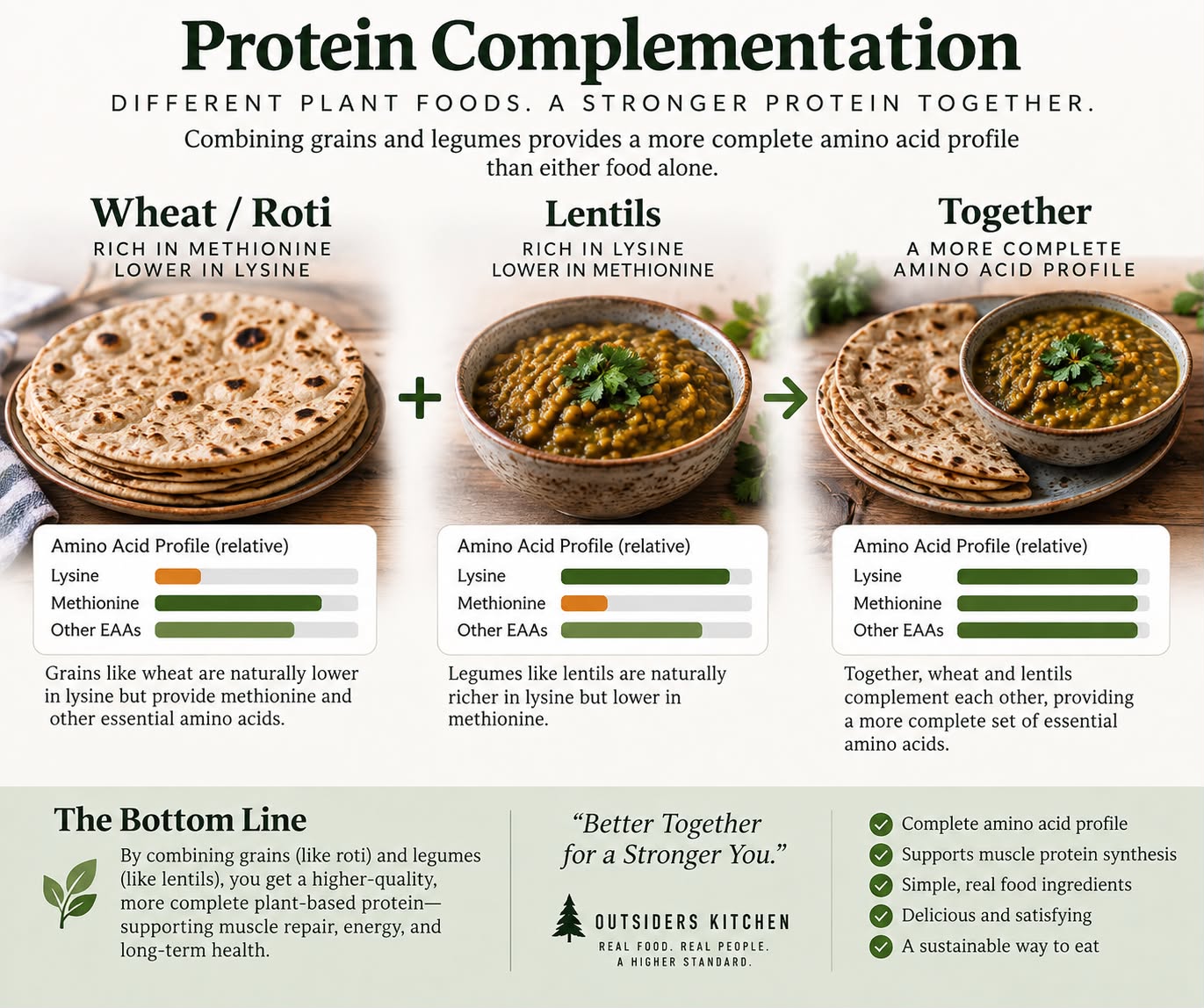
Cereal grains tend to be relatively low in lysine while providing more sulfur-containing amino acids.
Legumes such as lentils tend to provide considerably more lysine while being relatively limited in sulfur-containing amino acids such as methionine and cysteine.
Put them together and the amino-acid weakness of one food can be partially compensated for by the strength of the other.
This is called:
Protein Complementation
One example from the scientific literature illustrates the principle beautifully.
Rice and lentil proteins have different limiting amino acids.
Researchers have calculated that an appropriately proportioned combination can achieve substantially better overall protein quality than either protein alone.
That does not mean lentils magically cause you to “absorb twice as much protein.”
That’s not how we would describe the physiology.
Instead:
Adding lentils to a cereal-based meal can improve the amino-acid balance and protein quality of the combined meal.
That’s more accurate—and considerably more useful.
Absorption and Protein Quality Are Different Things
This distinction matters.
You’ll sometimes hear that combining certain plant proteins “increases protein absorption.”
That’s an oversimplification.
We prefer to say:
Complementary proteins can improve the essential-amino-acid profile and nutritional quality of the combined protein.
The proteins still have to be digested.
Their amino acids still have to be absorbed.
But once those amino acids become available, having adequate proportions of all the essential amino acids becomes important for synthesizing new proteins within the body.
So we don’t need an exaggerated claim such as:
“This increases protein absorption by 100%.”
The actual biology is much more interesting.
Why We Added Soy
There was another reason our original high-protein roti was interesting.
We didn’t simply add more wheat gluten.
We incorporated soy flour.
Compared with many plant proteins, soy has a strong essential-amino-acid profile and relatively high protein quality.
That makes soy particularly useful in predominantly plant-based diets.
It also changes the amino-acid mixture of a wheat-heavy food.
Instead of asking:
“Is wheat a complete protein?”
or:
“Is soy a complete protein?”
we think a more useful question is:
What does the entire meal provide?
That brings us to tofu.
High-Protein Rotis and Tofu
Take our high-protein roti.
Now add tofu.
We’ve introduced another substantial source of soy protein and another opportunity to build the protein content of the entire plate.
Tofu also gives someone following a vegan or plant-based diet an extraordinarily versatile option.
Imagine:
High-Protein Roti
with
Lentil Dal
and
Tofu Tikka
plus vegetables, herbs and spices.
Now we’re no longer asking:
“How much protein does the bread have?”
We’re asking:
“How intelligently did we construct the meal?”
That’s a much better question.
High-Protein Rotis and Greek Yogurt
For vegetarians who consume dairy, Greek yogurt gives us another excellent option.
The original Outsiders recipe actually incorporated Greek yogurt directly into the dough.
But yogurt can also become part of the finished meal.
Think:
High-Protein Roti + Dal + Greek Yogurt Raita
Now we have cereal, legume, soy and dairy protein represented across the meal.
And yogurt introduces another part of our story.
Leucine.
Lysine vs. Leucine: Why Both Matter
These two essential amino acids deserve separate attention.
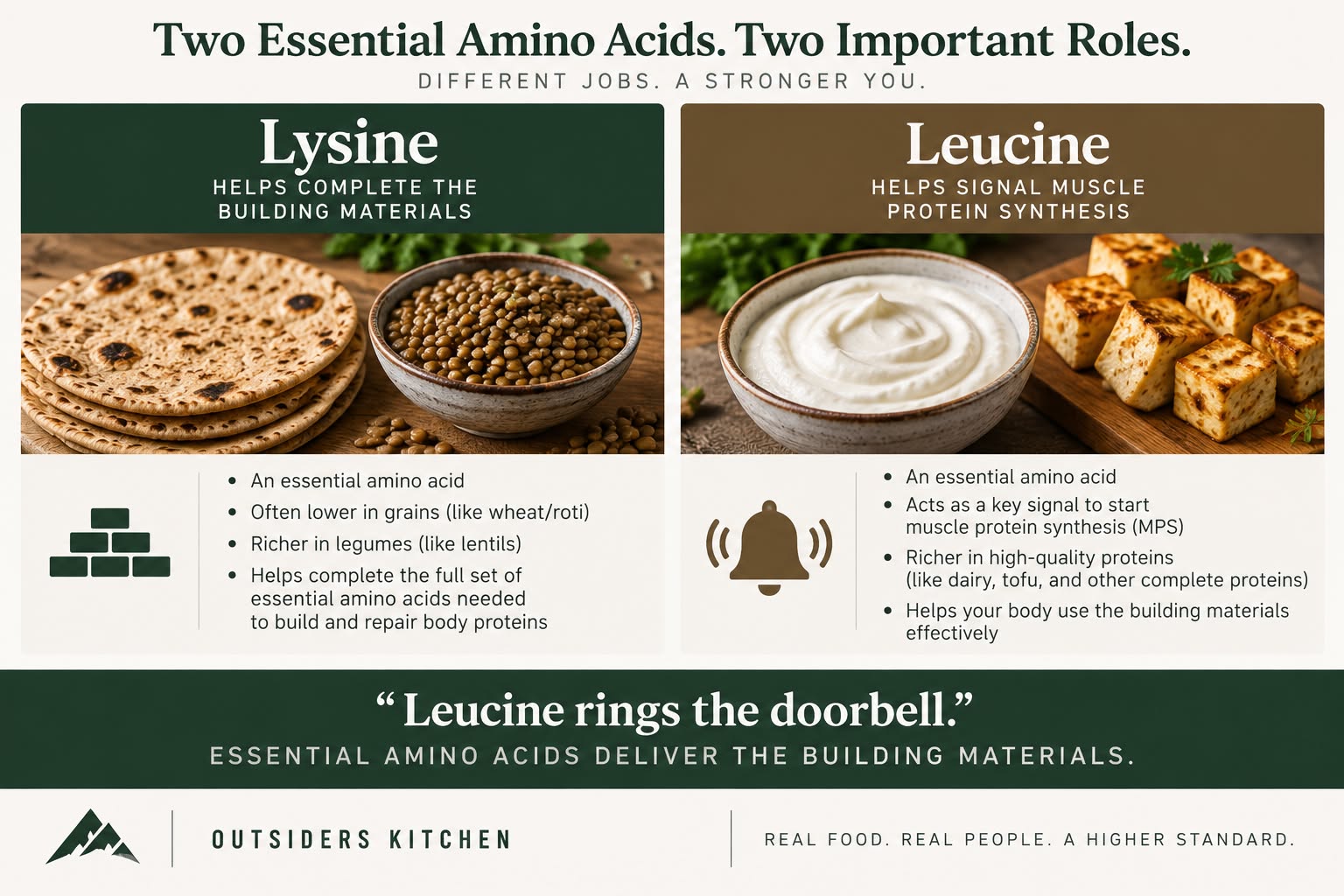
Lysine helps us think about protein quality.
Wheat is relatively lysine-poor.
Adding lysine-richer foods such as lentils, other legumes, soy or dairy helps create a better-balanced essential-amino-acid profile across the meal.
Leucine helps us think about muscle protein synthesis.
Leucine is an essential amino acid, but it also participates in the cellular signaling involved in initiating muscle protein synthesis, particularly through pathways involving mTORC1.
Here’s our favorite way to explain it:
Leucine rings the doorbell.
Essential amino acids deliver the building materials.
You need both.
Having a tremendous amount of leucine doesn’t eliminate the need for the other essential amino acids.
Turning on the construction crew doesn’t help very much if the truck containing the lumber never arrives.
How Much Leucine Do You Need?
You’ll frequently hear about a precise “leucine threshold.”
Human physiology isn’t quite that binary.
Research suggests that meals containing adequate high-quality protein and roughly a few grams of leucine can provide a strong stimulus for muscle protein synthesis under appropriate circumstances.
But there isn’t one magical leucine number that applies identically to everyone.
Age, activity, total protein intake, protein source, meal composition, digestion and training status can all influence the response.
So we don’t design meals around chasing one magical number.
We design meals around:
Adequate total protein + essential amino acids + protein quality + appropriate distribution throughout the day.
Leucine is an important part of that system.
It isn’t the entire system.
Plant Protein Isn’t “Bad Protein”
This article isn’t an argument against plant protein.
Far from it.
It’s an argument for understanding it.
Plant proteins vary enormously.
Some are relatively low in one essential amino acid.
Others have different digestion characteristics.
Soy performs quite well by common protein-quality measures, while many grains and legumes have different limiting amino acids.
For someone eating a predominantly plant-based diet, several strategies can help create a strong protein intake:
-
Eat enough total protein.
-
Consume a variety of protein sources.
-
Combine complementary foods such as grains and legumes.
-
Include lysine-rich foods.
-
Include protein sources that contribute meaningful leucine.
-
Distribute protein across meals.
-
Remember that the entire diet matters more than whether one individual food is “perfect.”
Most importantly:
Stop evaluating every food in isolation.
The Outsiders Vegetarian High-Protein Plate
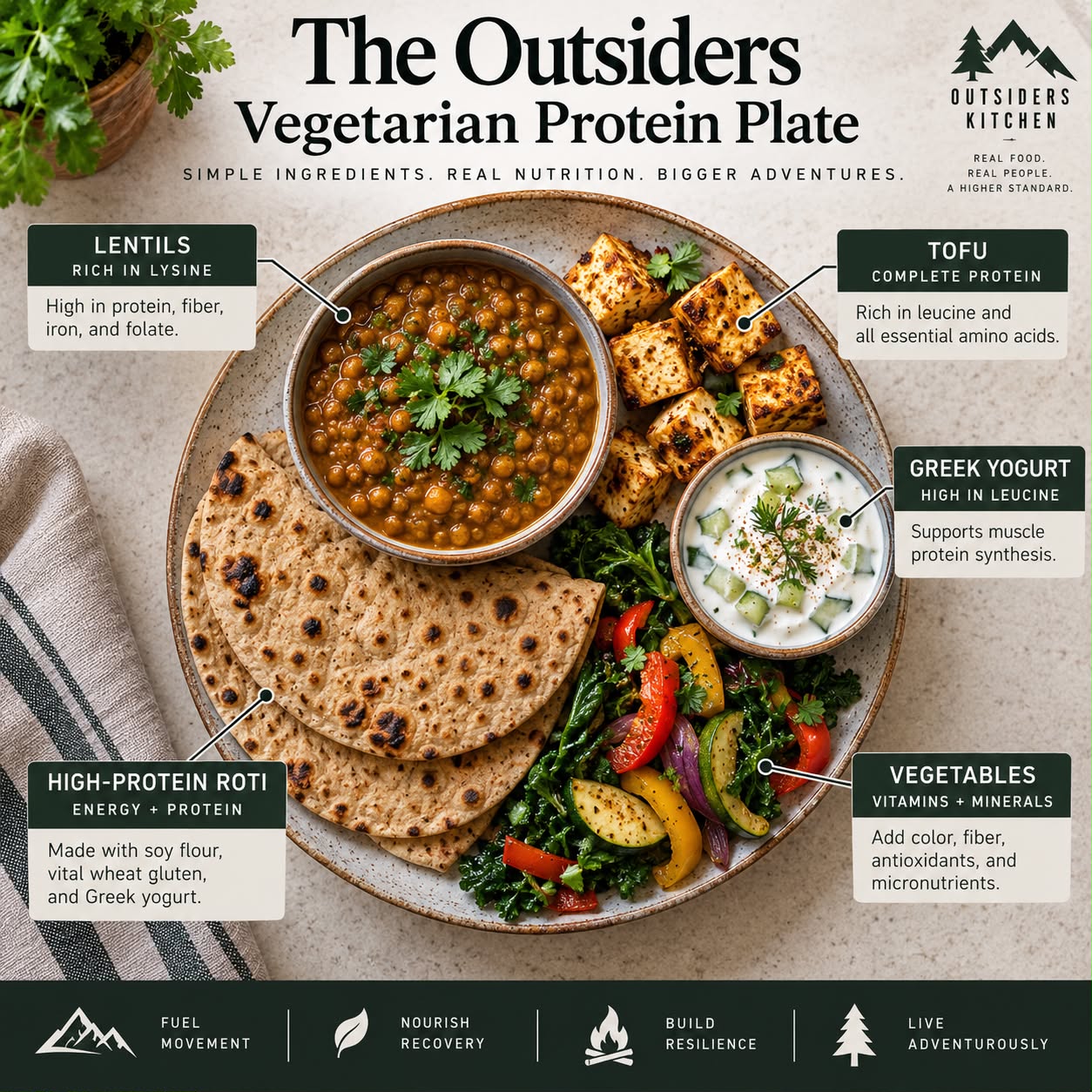
This gives us a simple framework for building a vegetarian meal around our roti.
1. Start With the High-Protein Roti
This provides the wheat-and-soy protein foundation.
2. Add Lentils or Another Legume
Dal, lentils, chickpeas or beans add additional protein and provide lysine-rich legume protein that complements the cereal component of the meal.
3. Add Tofu or Greek Yogurt
Tofu provides additional soy protein and works beautifully in plant-based meals.
Greek yogurt provides a highly useful dairy-protein option for vegetarians.
4. Add Vegetables
Build color, texture, micronutrients, fiber and volume.
5. Add Flavor From Actual Food
Ginger.
Garlic.
Cilantro.
Methi.
Chili.
Turmeric.
Cumin.
Spinach.
Onion.
Tomato.
Lemon.
Food should still taste like food.
Why Minimal Ingredients Matter
Ten years after creating this recipe, this may be the part of the philosophy we appreciate most.
We don’t believe a food becomes healthier simply because somebody puts the words:
HIGH PROTEIN
on the package.
Turn it around.
Read the ingredients.
Some modern high-protein foods require a long list of ingredients to reproduce the taste, texture, stability and shelf life of the original food.
Our philosophy is different.
Start with food.
Use ingredients for a reason.
If an ingredient doesn’t need to be there, question why it’s there.
Our original roti wasn’t complicated.
-
Soy flour.
-
Vital wheat gluten.
-
Greek yogurt.
-
A small amount of oil.
-
Water.
That’s essentially it.
And variations can remain just as recognizable:
-
Methi High-Protein Rotis
-
Spinach High-Protein Rotis
-
Chili-Ginger High-Protein Rotis
-
Garlic-Cilantro High-Protein Rotis
Real ingredients.
Real food.
Purposeful nutrition.
Are Organic Ingredients Better?
You’ll notice another word in the original recipe:
Organic.
We believe people should have the option to choose organic ingredients when practical and affordable.
But let’s be precise about what that means.
We don’t tell people:
“Organic automatically means more nutritious.”
The evidence doesn’t support such a sweeping statement.
Research examining organic and conventionally produced foods has found inconsistent differences in nutrient content.
Organic food consumption can, however, reduce exposure to certain detectable pesticide residues.
That’s a legitimate consideration.
So our philosophy is simple:
Choose organic when it aligns with your priorities, availability and budget.
But don’t allow the pursuit of a perfect ingredient to prevent you from preparing a fundamentally nutritious meal.
Organic lentils don’t make an otherwise poor diet healthy.
Conventionally grown lentils don’t make an otherwise excellent diet unhealthy.
Context matters.
How to Make the Outsiders High-Protein Roti
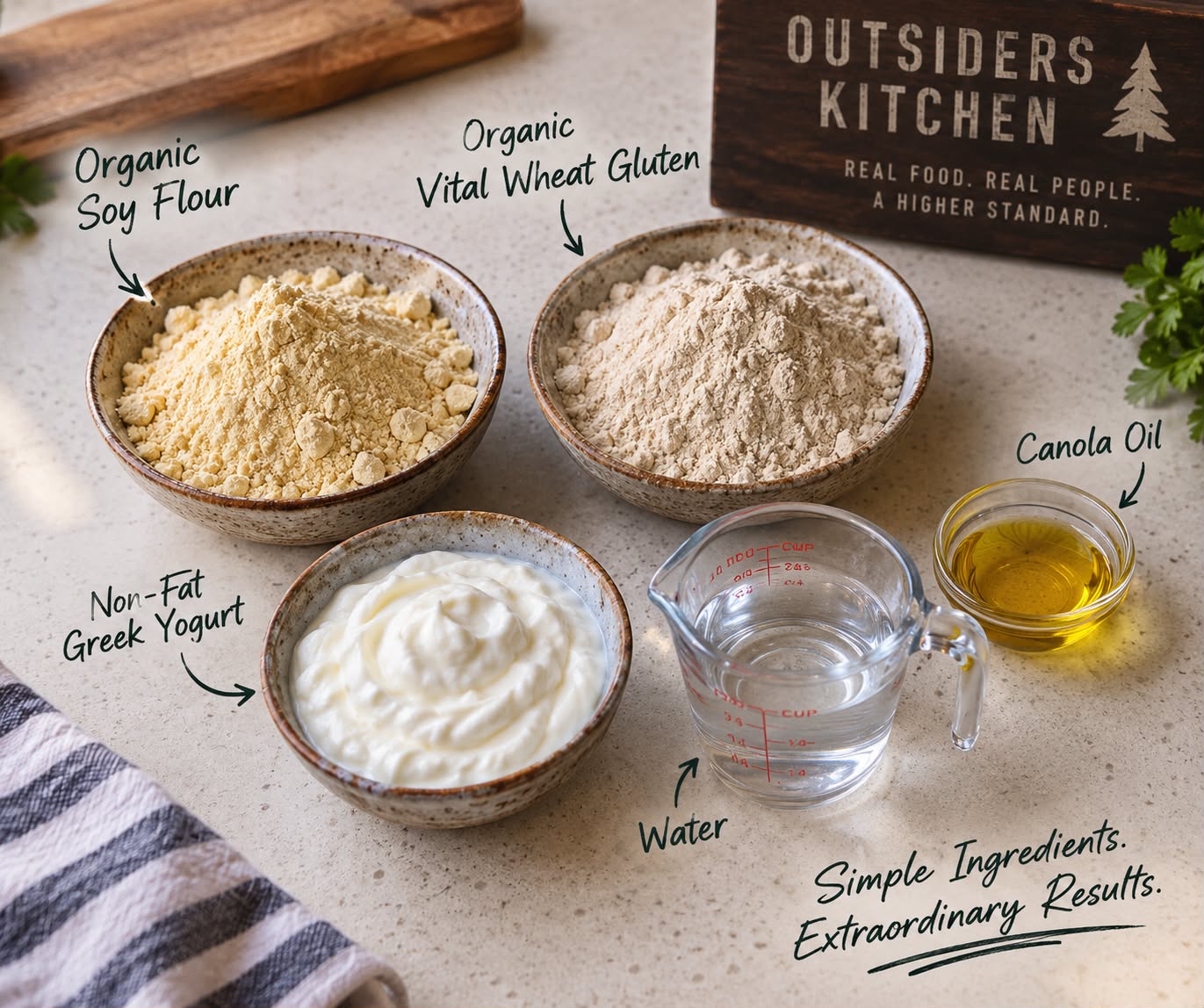
Ingredients
-
1 cup organic soy flour
-
100 grams organic vital wheat gluten
-
4 ounces plain nonfat Greek yogurt
-
2 teaspoons oil
-
Approximately 4½ tablespoons water, adjusted as necessary
Directions
Combine the soy flour and vital wheat gluten thoroughly.
Add the Greek yogurt and oil.
Slowly incorporate the water rather than adding it all at once.
Bring the mixture together into a workable dough.
Allow the dough to rest briefly so the flour can hydrate.
Divide evenly.
Roll each portion thinly into a roti.
Cook on a properly heated dry skillet or tawa, turning as necessary until cooked through with light browning.
The exact amount of water may vary slightly depending upon your flour, yogurt, humidity and desired texture.
Let the dough tell you what it needs.
High-Protein Roti Nutrition
Our original 2016 calculations were approximately:
-
107 calories per roti
-
17 grams protein
-
7 grams carbohydrate
-
1.5 grams fat
-
2.3 grams fiber
Nutrition values can vary considerably according to ingredient brand, serving size and the number of rotis produced from a batch.
If exact macronutrients matter to you, calculate the nutrition information using the actual products you use and divide the total recipe by the finished number of rotis.
Three High-Protein Roti Meal Ideas
Vegetarian High-Protein Roti Meal
-
High-Protein Roti
-
Lentil Dal
-
Greek Yogurt Raita
-
Vegetables
The lentils provide lysine-rich legume protein, while yogurt adds dairy protein to an already wheat-and-soy-based roti.
Plant-Based High-Protein Meal
-
High-Protein Roti prepared with a suitable non-dairy modification
-
Lentil Dal
-
Tofu Tikka
-
Vegetables
Now cereal, legume and soy proteins contribute across the plate.
The Outsiders Adventure Wrap

-
High-Protein Roti
-
Thick lentil or chickpea filling
-
Tofu or Greek-yogurt-based accompaniment
-
Spinach or greens
-
Herbs and spices
Roll it.
Wrap it.
Pack it.
Eat it.
Nutrition doesn’t have to look like nutrition.
Do Vegetarians Have to Combine Proteins at Every Meal?
No.
This is an old nutritional misconception worth clearing up.
Someone consuming adequate calories, sufficient total protein and a varied vegetarian diet does not need to anxiously match complementary proteins at every single meal.
Your body maintains amino-acid pools, and protein consumed across the diet contributes to meeting your needs.
But there is an important distinction between:
“Do I have to do this?”
and
“Can I intentionally design a better high-protein meal?”
For active people—especially people training for strength, endurance, recovery and healthy aging—we think deliberately constructing protein-rich meals makes tremendous sense.
Not because every plate must achieve biochemical perfection.
Because good nutrition becomes easier when meals are designed deliberately.
Frequently Asked Questions About High-Protein Rotis
Is roti high in protein?
Traditional roti contains protein because wheat contains protein, but it isn’t generally considered a particularly protein-dense food.
Increasing the proportion of protein-rich ingredients such as soy and vital wheat gluten can substantially increase the protein content.
Our original Outsiders recipe was calculated at approximately 17 grams of protein per roti, although the exact value depends upon ingredients and serving size.
How can I increase the protein in roti?
Instead of simply adding more of one protein source, consider both protein quantity and quality.
Soy flour can increase protein content.
Vital wheat gluten dramatically increases wheat protein.
Greek yogurt can add additional protein and alter the dough.
Then consider what accompanies the roti.
Lentils, tofu, Greek yogurt, chickpeas and other protein-rich foods can transform the nutritional profile of the entire meal.
Why pair roti with lentils?
Wheat is relatively limited in lysine, while lentils and other legumes provide considerably more lysine.
Their amino-acid profiles therefore complement one another.
This doesn’t mean lentils magically increase the amount of wheat protein absorbed.
It means the combined meal can provide a better balance of essential amino acids.
Are lentils a complete protein?
Lentils contain all of the essential amino acids, but their proportions and digestibility determine their protein quality.
They are relatively rich in lysine compared with cereal grains but more limited in sulfur-containing amino acids.
That’s one reason cereal-legume combinations are so useful.
Is soy a good protein source?
Yes.
Soy has one of the stronger essential-amino-acid profiles among commonly consumed plant proteins and performs relatively well on modern protein-quality measures.
Soy flour and tofu can therefore be useful foods for people seeking to increase plant-based protein intake.
Why is lysine important for vegetarians?
Lysine is an essential amino acid.
Because cereal grains tend to be relatively low in lysine, people eating predominantly plant-based diets can benefit from regularly including lysine-rich foods such as legumes and soy.
This doesn’t require obsessively calculating lysine at every meal.
It means dietary variety matters.
Why is leucine important?
Leucine is an essential amino acid that also participates in the cellular signaling involved in muscle protein synthesis.
But leucine isn’t muscle protein by itself.
The body still requires the other essential amino acids as building materials.
Think of it this way:
Leucine rings the doorbell.
The essential amino acids deliver the building materials.
Is high-protein roti good for building muscle?
It can certainly contribute to a protein-rich diet, but no individual food builds muscle by itself.
Resistance training provides the stimulus.
Adequate protein and energy provide nutritional support.
Sleep and recovery help adaptation occur.
A high-protein roti combined with complementary protein sources can be one useful meal within that larger system.
Is this high-protein roti vegan?
The original Outsiders recipe is vegetarian but not vegan because it contains Greek yogurt.
A vegan version would require replacing the Greek yogurt with an appropriate plant-based ingredient while maintaining the hydration and structural properties necessary for the dough.
Does organic roti contain more protein?
Not inherently.
Organic production and protein content are separate questions.
We choose organic ingredients when practical based on our broader ingredient philosophy—not because the word “organic” automatically means higher protein or greater nutritional value.
Stop Thinking About Individual Foods. Start Thinking About Systems.
This is ultimately why we wanted to revisit a ten-year-old roti recipe.
At Outsiders, we’ve spent decades teaching people not to evaluate the body as a collection of isolated parts.
A painful knee doesn’t necessarily mean the problem begins at the knee.
A squat isn’t simply a quadriceps exercise.
Running isn’t simply moving your legs faster.
The body is a system.
Nutrition works much the same way.
Instead of asking:
“Is roti healthy?”
Ask:
What is the roti made from?
Instead of asking:
“Does this have protein?”
Ask:
What proteins am I eating across the meal?
Instead of asking:
“Is plant protein complete?”
Ask:
Am I consuming enough total protein and enough essential amino acids from a varied diet?
Instead of asking:
“How do I maximize leucine?”
Ask:
Does my meal provide adequate protein and the collection of essential amino acids my body needs?
Those are better questions.
Better questions lead to better decisions.
Ten Years Later
In 2016, we were trying to make a really high-protein roti.
And we did.
But looking back, the recipe represents something bigger.
It represents the way we’ve always approached health and performance.
Don’t remove something simply because you don’t understand how to make it work.
Learn.
Experiment.
Measure.
Improve.
Keep what works.
Discard what doesn’t.
And make the solution simple enough that real people can actually use it.
Traditional foods don’t necessarily need to be replaced with manufactured “fitness foods.”
Sometimes they simply need to be understood.
A roti can provide carbohydrates and protein.
Soy can contribute additional protein and essential amino acids.
Lentils can provide complementary lysine-rich legume protein.
Tofu can add additional soy protein.
Greek yogurt can provide another protein source for vegetarians.
Leucine participates in signaling the muscle-building response.
The remaining essential amino acids provide the materials necessary to carry it out.
Vegetables, herbs and spices build the rest of the meal.
And suddenly we’re no longer talking about a high-protein piece of bread.
We’re talking about a system for constructing food.
That is the lesson we didn’t completely understand when two high-protein roti scientists walked into the original Outsiders Kitchen ten years ago.
We just knew we were onto something.
Turns out…
we were.
The Outsiders Principle
Don’t judge a meal by one number.
Calories matter.
Protein matters.
Ingredients matter.
Protein quality matters.
Amino acids matter.
The foods surrounding it matter.
And your overall diet matters most.
Build the meal.
Build the system.
Then let consistency do the work.
Research & Further Reading
For readers interested in going deeper, the principles discussed in this article are supported by research examining protein quality, indispensable amino acids, plant-protein complementation, leucine and muscle protein synthesis.
FAO — Dietary Protein Quality Evaluation in Human Nutrition
The Food and Agriculture Organization’s expert consultation established the scientific framework for DIAAS and evaluating digestible indispensable amino acids.
Herreman et al. — Comprehensive overview of the quality of plant- and animal-sourced proteins based on DIAAS
Food Science & Nutrition.
Useful for understanding differences among protein sources and why total protein grams alone don’t describe protein quality.
Dimina et al. — Combining plant proteins to achieve amino acid profiles adapted to various nutritional objectives
Nutrients.
Explores how different plant proteins can complement one another to improve amino-acid profiles.
Gorissen & Witard — Characterising the muscle anabolic potential of dairy, meat and plant-based protein sources in older adults
Proceedings of the Nutrition Society.
Discusses protein source, amino-acid composition, leucine and the muscle-protein-synthesis response.
van Vliet, Burd & van Loon — The skeletal muscle anabolic response to plant- versus animal-based protein consumption
Journal of Nutrition.
Reviews differences between plant and animal proteins and strategies that may improve the anabolic response to plant proteins.
Gorissen et al. — Protein content and amino acid composition of commercially available plant-based protein isolates
Amino Acids.
Provides useful data on the amino-acid composition of plant-derived proteins.
Messina — Soy and health update: evaluation of the clinical and epidemiologic literature
Nutrients.
A broad review of soy foods and human health.
Smith-Spangler et al. — Are organic foods safer or healthier than conventional alternatives?
Annals of Internal Medicine.
A systematic review useful for distinguishing evidence about nutrient content from pesticide-residue exposure.
About The Outsiders Bootcamp
For more than two decades, we’ve approached fitness, nutrition and human performance with a simple philosophy:
Understand the system before trying to optimize the parts.
We believe in evidence before trends.
Mechanics before intensity.
Simple ingredients before unnecessary complexity.
And sustainable behaviors before short-term perfection.
The original Outsiders Kitchen was simply another place to experiment with those ideas.
Ten years later, we’re still experimenting.
We’re just asking better questions.
Evidence Standards
This article is intended for general education and isn’t individualized medical or nutritional advice.
Where established nutrition science supports a relationship, we’ve attempted to describe it conservatively.
Where we apply those principles to the Outsiders recipe or recommend particular meal combinations, those are Outsiders applications of the underlying science, not claims that this specific recipe or meal has undergone clinical testing.
We believe authority doesn’t come from making the biggest claim.
It comes from being precise about what we actually know.
Stay connected with news and updates!
Join our mailing list to receive the latest news and updates from our team. Don't worry, your information will not be shared.
We hate SPAM. We will never sell your information, for any reason.
