
A New Word for an Ancient Human Instinct
Sep 18, 2026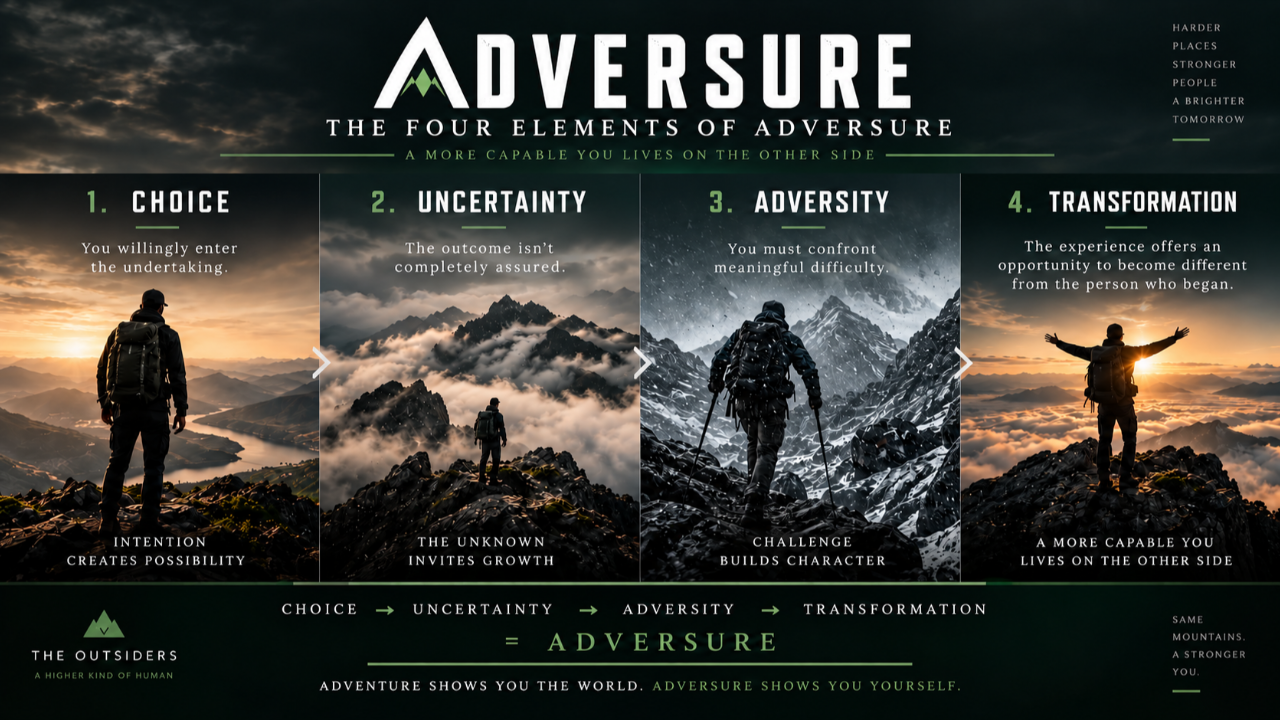
ADVERSURE
Why Humans Choose Hard Things
A New Word for an Ancient Human Instinct
Coined by Michael Rawski — September 2026
There are experiences we endure because we have no choice.
And then there are experiences we choose precisely because they will be difficult.
We climb mountains.
We run ultramarathons.
We cross wilderness.
We walk through the night.
We sleep outside.
We travel somewhere unfamiliar.
We attempt something without knowing whether we can finish.
We voluntarily exchange comfort for uncertainty.
Why?
It isn’t simply because we enjoy suffering.
And it isn’t adequately explained by the word adventure.
Sometimes we deliberately choose difficult experiences because we suspect that somewhere inside the difficulty is an opportunity to discover something about ourselves.
We aren’t merely seeking a destination.
We’re seeking the person who might arrive there.
English has words for many pieces of this experience.
Adventure.
Adversity.
Endurance.
Resilience.
Grit.
Fortitude.
Challenge.
But there does not appear to be a commonly established English word that precisely describes the deliberate pursuit of meaningful adversity for the growth or transformation that confronting it may produce.
I believe there should be.
So I propose one.
ADVERSURE
adversure
noun
A deliberately chosen undertaking involving meaningful difficulty, uncertainty, or adversity, pursued partly for the personal growth, discovery, or transformation that confronting those challenges may produce.
Etymology: formed from adversity and venture, with a deliberate echo of adventure.
An adventure is something you experience.
An adversure is something you choose partly because of what overcoming it may require you to become.
Adventure Shows You the World. Adversure Shows You Yourself.
Imagine standing at the beginning of a trail knowing you have 50 miles ahead of you.
You know there will be fatigue.
Your feet may hurt.
The temperature will change.
Darkness will come.
You will eventually reach the point where stopping feels easier than continuing.
You could stay home.
Nothing is forcing you onto that trail.
And yet you go.
Why?
The obvious answer might be:
Adventure.
But imagine someone offered you the same finish line without requiring the 50 miles.
You could drive there.
Step out of the vehicle.
Take the photograph.
Receive the medal.
Tell everyone you reached the destination.
Would it mean the same thing?
Of course not.
Because the destination was never the entire point.
The difficulty mattered.
Something had to be earned.
Something had to be confronted.
And something had to happen between the person who started and the person who finished.
That space between those two people is where adversure lives.
We Already Know the Pieces
Psychologists studying extended expeditionary adventurers have found something remarkably similar.
Research by Paula Reid and Hanna Kampman explored why experienced adventurers deliberately undertake demanding expeditions. Participants described themes involving uncertainty, autonomy, resilience and growth. The researchers concluded that enduring expeditionary adventures may accelerate personal growth and facilitate psychological well-being.
The researchers described adventure as, in part, knowingly entering the unknown.
More recent research examining hard adventure tourism has explicitly discussed voluntary hardship as a setting in which self-transformation can occur.
None of this means hardship automatically makes someone better.
It doesn’t.
But it supports something humans appear to have understood intuitively for a very long time:
Certain difficult experiences can become powerful environments for learning about ourselves.
Adversure Is Not Adversity
Adversity happens to you.
Adversure is entered voluntarily.
Losing someone you love is adversity.
Becoming seriously ill is adversity.
Losing your livelihood is adversity.
Being caught in a natural disaster is adversity.
Those experiences may ultimately produce growth, but you did not choose them for that purpose.
Adversure begins with agency.
You step toward the challenge.
Adversure Is Not Simply Adventure
Adventure and adversure overlap.
But they aren’t identical.
You can have an adventure without significant hardship.
You can explore a beautiful city.
Take an unexpected road trip.
Visit somewhere you’ve never been.
Try an unfamiliar activity.
Those can be wonderful adventures.
Adversure requires something else.
Meaningful difficulty.
The challenge isn’t an unfortunate side effect of the experience.
It contributes to its value.
Adventure asks:
What will I experience?
Adversure asks:
Who might I become through the experience?
Adversure Is Not Suffering for the Sake of Suffering
This distinction matters.
Pain alone is not adversure.
Recklessness is not adversure.
Self-punishment is not adversure.
Danger for entertainment is not adversure.
Making an experience unnecessarily miserable doesn’t make it more meaningful.
The objective isn’t suffering.
The objective is growth through meaningful challenge.
Difficulty is the environment.
Transformation is the possibility.
The Four Elements of Adversure
For an experience to qualify as adversure, I propose that four elements should be present.
1. Choice
You willingly enter the experience.
Agency is fundamental.
Someone forced into hardship is experiencing adversity.
Someone deliberately stepping toward meaningful hardship may be entering adversure.
2. Uncertainty
The outcome cannot feel completely guaranteed.
There needs to be a meaningful question:
Can I do this?
That uncertainty creates the psychological territory where discovery becomes possible.
3. Adversity
Something meaningful must be confronted.
Fatigue.
Fear.
Distance.
Weather.
Isolation.
Altitude.
Skill.
Patience.
Failure.
Discomfort.
Self-doubt.
The obstacle will vary.
But something must require you to reach beyond your ordinary response.
4. Transformation
The experience offers an opportunity for growth, discovery or change.
Not every adversure will transform someone.
There are no guarantees.
But transformation must at least be part of the possibility—and part of why the challenge has value.
Choice.
Uncertainty.
Adversity.
Transformation.
Together, they create adversure.
The Adversure Spectrum
There is another reason we need this distinction.
Human difficulty exists along a spectrum.
COMFORT → CHALLENGE → ADVENTURE → ADVERSURE → UNCHOSEN ADVERSITY
Comfort asks little from us.
Challenge tests an ability.
Adventure introduces exploration and uncertainty.
Adversure deliberately combines meaningful challenge with the possibility of transformation.
Adversity removes the requirement of choice entirely.
Understanding those distinctions prevents us from romanticizing suffering while still recognizing something important:
Humans sometimes benefit enormously from choosing difficult things.
What Counts as Adversure?
A first marathon could be adversure.
So could climbing a mountain.
Crossing a wilderness.
Learning to surf later in life.
Completing a long-distance trek.
Spending days backpacking alone.
Attempting an ultramarathon.
Learning an extraordinarily difficult skill.
Traveling somewhere that forces you outside your cultural comfort zone.
Returning to school at 50.
Starting something meaningful when failure is genuinely possible.
Adversure does not necessarily require mountains.
It doesn’t require athletics.
It doesn’t even require wilderness.
The mountain can be literal.
Or metaphorical.
What matters is that you voluntarily enter meaningful difficulty because something on the other side of confronting it is worth discovering.
The Adversurist
If adversure describes the experience, we also need a word for the person.
adversurist
noun
A person who deliberately pursues meaningful difficult experiences partly for the growth, discovery or transformation that confronting them may produce.
An adversurist does not worship suffering.
They don’t need to be fearless.
In fact, fear can be part of the reason for going.
They recognize that comfort and safety have enormous value.
But they also recognize that a life engineered to eliminate every difficult experience may eliminate some opportunities to discover what they’re capable of.
So occasionally, deliberately and intelligently, they choose the harder path.
Not because it is harder.
Because of what that particular difficulty may teach them.
The Summit Is Not the Point
Mountains provide a particularly beautiful illustration.
Thousands of people have stood on mountain summits.
Standing there isn’t what makes climbing transformative.
It’s everything required to get there.
Training.
Preparation.
Early mornings.
Uncertainty.
Cold.
Fatigue.
Fear.
Patience.
Mistakes.
Humility.
Continuing when quitting becomes attractive.
Sometimes turning around when continuing would be foolish.
And eventually understanding that the mountain doesn’t care whether you reach its summit.
The mountain simply creates conditions in which you meet yourself.
That is adversure.
Why Humans May Need Adversure
Modern civilization has accomplished something extraordinary.
We have spent thousands of years removing unnecessary hardship from human life.
That is progress.
Clean water is progress.
Medicine is progress.
Reliable shelter is progress.
Transportation is progress.
Food security is progress.
Safety is progress.
We should not romanticize the suffering those advances eliminated.
But perhaps another question follows:
What happens when we remove almost every opportunity to encounter meaningful difficulty as well?
The answer isn’t to manufacture pointless suffering.
It may simply be to occasionally choose worthwhile challenges.
Walk farther.
Climb higher.
Learn something difficult.
Go somewhere unfamiliar.
Attempt something whose outcome isn’t certain.
Enter an experience that requires preparation, humility and perseverance.
Not because comfort is bad.
But because comfort cannot teach us everything.
The Paradox of Adversure
There is a beautiful paradox here.
We voluntarily enter experiences that we may desperately wish would end while we’re inside them.
And afterward, those can become some of the experiences we’re most grateful we had.
During the climb:
Why am I doing this?
After the climb:
When can I do something like this again?
Perhaps that’s because the challenge gives us something comfort rarely can:
evidence.
Evidence that we can continue.
Evidence that fear doesn’t always have to make the decision.
Evidence that discomfort is survivable.
Evidence that our perceived limits aren’t always our actual limits.
Evidence that we can learn.
Adapt.
Fail.
Recover.
Try again.
And sometimes, evidence that we are capable of considerably more than the person who began believed.
An Invitation
Adversure doesn’t require Everest.
Your adversure only needs to be meaningful to you.
For one person, it might be 100 miles.
For another, their first mile.
For one person, it might be crossing a continent.
For another, sleeping outside for the first time.
For one person, it might be climbing a mountain.
For another, simply beginning something they’ve been afraid to begin.
Difficulty isn’t meaningful because someone else thinks it’s difficult.
It becomes meaningful because of what confronting it requires from you.
So perhaps the question isn’t:
How hard can I make my life?
That’s the wrong question.
Perhaps the better question is:
What meaningful difficulty am I willing to choose because of who I might become through confronting it?
Find that thing.
Prepare intelligently.
Respect the risks.
Step toward uncertainty.
And see who meets you on the other side.
That is adversure.
THE WORD
ADVERSURE
noun
A deliberately chosen undertaking involving meaningful difficulty, uncertainty, or adversity, pursued partly for the personal growth, discovery, or transformation that confronting those challenges may produce.
ADVERSURIST
noun
A person who deliberately pursues adversure.
Four Elements
CHOICE → UNCERTAINTY → ADVERSITY → TRANSFORMATION
The Idea
Adventure shows you the world.
Adversure shows you yourself.
— Michael Rawski, 2026
Stay connected with news and updates!
Join our mailing list to receive the latest news and updates from our team. Don't worry, your information will not be shared.
We hate SPAM. We will never sell your information, for any reason.
