
YOU WERE WORTHY BEFORE YOU GOT HEALTHY
Sep 24, 2026Cognitive Restructuring, Human Worth, and Learning to Care for Yourself Without Guilt

There is a strange question hiding underneath many of our attempts to become healthier.
We rarely say it out loud.
We may not even realize we are asking it.
But somewhere underneath the workouts, diets, responsibilities, expectations, missed appointments, exhaustion, guilt, and promises to “start again Monday,” there can be a much deeper question:
Am I worth taking care of?
Most of us would immediately answer yes.
Of course.
But our behavior can tell a more complicated story.
We stay up late finishing things for everyone else while sacrificing sleep.
We postpone the doctor’s appointment.
We tell ourselves we’ll exercise when work calms down.
We feel guilty taking an hour for ourselves.
We believe rest must be earned.
We describe food as something we have been “good” or “bad” for eating.
We exercise to compensate for dinner.
We compare our bodies to other people’s bodies.
We miss several workouts and somehow transform a few missed workouts into a judgment about our character.
We take care of everyone around us and put ourselves at the bottom of the list.
And sometimes, beneath all of this, is an assumption we have rarely stopped to examine:
Care must be earned.
Maybe through productivity.
Maybe through sacrifice.
Maybe through achievement.
Maybe through becoming thin enough, strong enough, successful enough, disciplined enough, useful enough, or good enough.
And once we finally become that person?
Then perhaps we’ll feel worthy of taking care of ourselves.
But what if we have the equation backward?
What if your health was never supposed to make you worthy?
What if taking care of yourself could begin with a completely different premise?
You were worthy before you got healthy.
THE BELIEF UNDERNEATH THE BEHAVIOR
Knowing What to Do Isn’t Always Enough
Most adults already know many of the basic behaviors associated with health.
Move your body.
Eat nutritious food.
Sleep.
Recover.
Manage stress.
Drink water.
Maintain meaningful relationships.
Get appropriate medical care.
Avoid smoking.
Limit behaviors that harm you.
You can certainly debate the details.
But the broad principles aren’t mysterious.
And yet knowing what to do and consistently doing it are very different things.
There are countless practical reasons for that.
Time.
Money.
Work.
Children.
Illness.
Access.
Stress.
Environment.
Injury.
Transportation.
Competing responsibilities.
We shouldn’t reduce every difficulty with health behavior to mindset.
But sometimes another obstacle exists underneath the practical ones:
the way we think about ourselves.
Consider some familiar thoughts:
“I don’t have time for myself.”
“Everyone else needs me.”
“I should be able to handle this.”
“I haven’t done enough today to rest.”
“I only exercised for twenty minutes, so it doesn’t really count.”
“I ate terribly yesterday.”
“I’ve already ruined the week.”
“I’ll feel better about myself once I lose the weight.”
“I shouldn’t need help.”
“I’ll take care of myself when things calm down.”
These may sound like observations.
But many contain assumptions.
And assumptions can be examined.
WHEN WORTH BECOMES CONDITIONAL
The Invisible Equation
Imagine an invisible equation running quietly in the background of someone’s life:
Achievement → Approval → Worth
For someone else:
Appearance → Acceptance → Worth
Or:
Sacrifice → Usefulness → Worth
Or:
Productivity → Success → Worth
Psychologists have studied something related to this idea through what are called contingencies of self-worth.
Jennifer Crocker and Connie Wolfe proposed that people differ in the domains upon which they stake their self-esteem. When self-worth becomes heavily dependent upon succeeding within a particular domain, success and failure within that domain can produce corresponding fluctuations in self-esteem.
That makes intuitive sense.
If being successful is something you strongly value, failure hurts.
But there is an important difference between:
“Success matters to me.”
and:
“Success determines what I am worth.”
The first allows us to pursue excellence.
The second makes every outcome a referendum on the self.
The same distinction can appear in health.
“I want to become stronger.”
can become:
“I need to become stronger so I won’t feel weak.”
“I would like to lose weight.”
can become:
“I’ll finally feel good about myself when I lose weight.”
“I want to complete this race.”
can become:
“If I quit, I’ll be a failure.”
The behavior may look identical from the outside.
The psychological foundation can be completely different.
THE MOVING FINISH LINE
Conditional worth creates an interesting problem.
There is always another condition.
Lose ten pounds.
Then another five.
Run a 5K.
Then a half marathon.
Get the promotion.
Then get the next one.
Earn more.
Become more productive.
Become a better parent.
Become more disciplined.
Become more impressive.
Help more people.
Make fewer mistakes.
Finally get everything together.
Then perhaps you’ll feel like enough.
Except human beings are extraordinarily good at moving finish lines.
Yesterday’s extraordinary accomplishment becomes today’s baseline.
The body changes.
Someone else performs better.
Another goal appears.
Another responsibility arrives.
And if worth lives on the other side of accomplishment, we may spend an entire lifetime trying to reach something that continually moves away from us.
This is particularly dangerous when fitness itself becomes part of the equation.
Exercise can become proof of discipline.
Body composition can become proof of virtue.
Food can become morality.
Rest can become weakness.
Health can become another performance.
Instead of taking care of ourselves because we matter, we attempt to become healthy enough to finally believe that we do.

YOU ARE A HUMAN BEING, NOT A HUMAN DOING
Here we need to make an important distinction.
Science can study self-esteem.
It can study self-compassion.
It can investigate self-criticism, motivation, stress, behavior, depression, anxiety, body image, exercise adherence, and health outcomes.
It can study what happens when self-esteem depends heavily upon particular achievements.
But science cannot place a human being on a scale and measure their intrinsic worth.
The proposition that human beings possess worth independent of achievement is a philosophical premise, not a laboratory finding.
At Outsiders, we are willing to state that premise clearly.
Your human worth does not need to be earned through performance.
Consider what happens when we separate two things we frequently combine:
What you do
and
what you are worth.
What you do changes constantly.
Your productivity changes.
Your income changes.
Your body changes.
Your abilities change.
Your relationships change.
Your health changes.
Your performance changes.
Eventually age will change things you once believed were permanent.
If human worth rests entirely upon those variables, then human worth becomes extraordinarily fragile.
So we begin somewhere else.
You possess value before the accomplishment.
Before the transformation.
Before the weight loss.
Before the race.
Before the promotion.
Before everyone approves of you.
Before you become the person you are trying to become.
And from that premise comes a very different approach to health.
COGNITIVE RESTRUCTURING
Your Thoughts Are Not Automatically Facts
One of the central ideas behind cognitive behavioral therapy is remarkably simple:
Our interpretation of an event influences how we experience and respond to it.
That doesn’t mean circumstances aren’t real.
It doesn’t mean pain isn’t real.
It doesn’t mean every problem can be thought away.
And it certainly doesn’t mean that if something bad happens, you simply need to “think positively.”
Cognitive restructuring is more sophisticated than that.
It involves learning to notice thoughts, examine assumptions, evaluate evidence, identify potentially distorted patterns of thinking, and develop interpretations that are more balanced and useful.
The goal isn’t:
Negative thought → positive thought
The process is closer to:
Automatic thought → examination → evidence → alternative interpretation → response
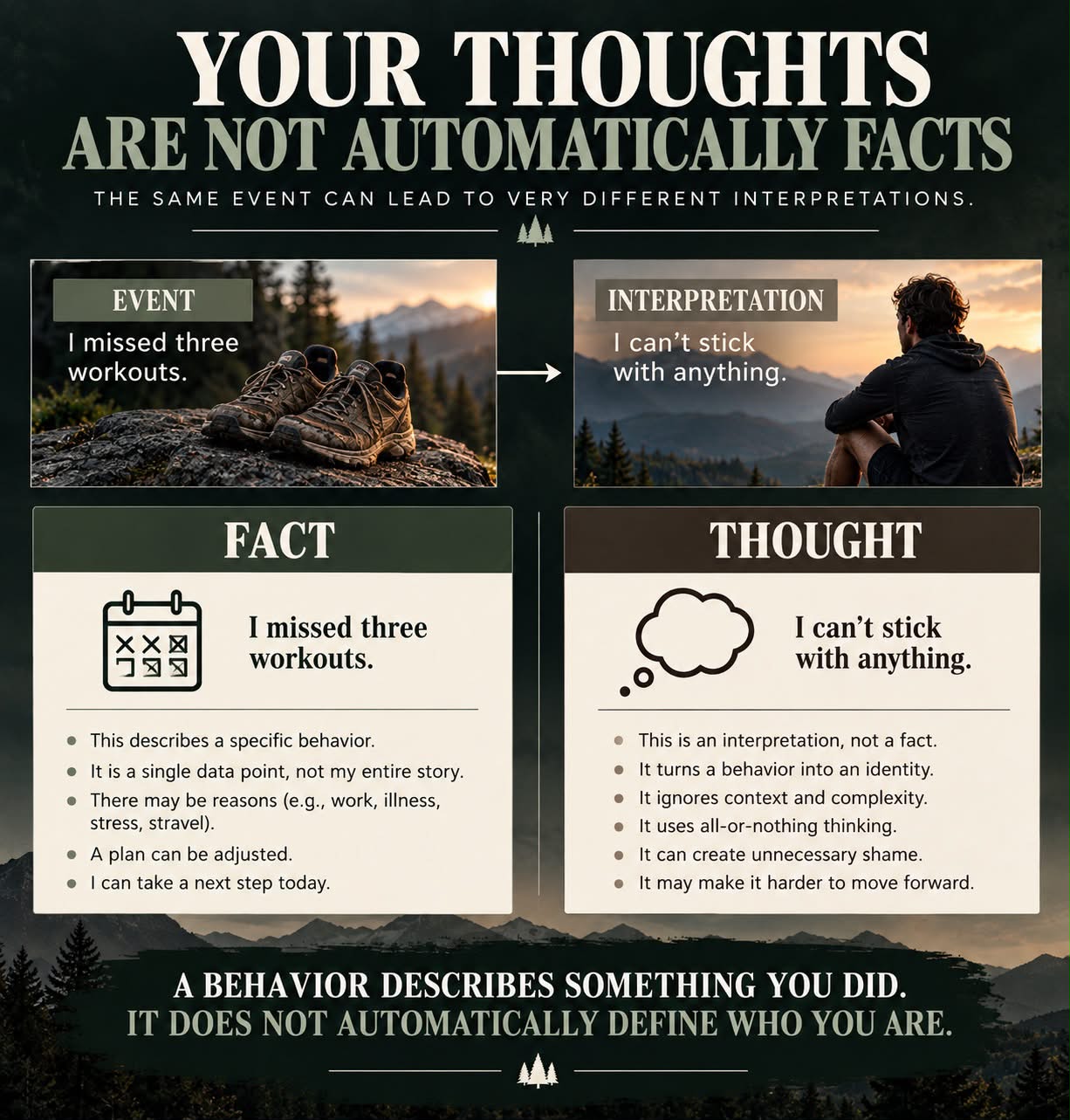
Imagine missing three workouts.
One interpretation might be:
“I can’t stick with anything.”
But is that a fact?
No.
The fact is:
You missed three workouts.
Everything after that is interpretation.
Perhaps work became overwhelming.
Perhaps you were sick.
Perhaps the program was unrealistic.
Perhaps you simply made choices you now wish you had made differently.
Those things can be examined.
But:
“I missed three workouts”
and
“I am incapable of commitment”
are not the same statement.
One describes behavior.
The other defines the person.
That distinction matters.
THE BELIEFS BENEATH THE THOUGHT
Automatic thoughts frequently sit on top of deeper assumptions.
Imagine you’re exhausted.
Your body is asking for recovery.
But you think:
“I shouldn’t take today off.”
Ask why.
“Because I need to be disciplined.”
Why?
“Because disciplined people don’t skip workouts.”
Why does that matter?
“Because otherwise I’m being lazy.”
And what would being lazy mean?
Perhaps eventually you arrive at something like:
“If I’m not productive, I’m less valuable.”
Now we’re no longer discussing a workout.
We’re discussing identity.
This is why simply giving someone another workout program doesn’t always solve the problem.
Sometimes the behavior is sitting on top of a belief system.
And changing the behavior sustainably may require examining the belief.
THE THOUGHTS THAT MAKE CARE HARDER
All-or-Nothing Thinking
“If I can’t work out for an hour, there’s no point.”
A more balanced interpretation:
Twenty minutes doesn’t become worthless because sixty minutes would have been better.
Should Statements
“I shouldn’t be tired.”
“I should be able to handle this.”
“I shouldn’t need recovery.”
Ask:
Where did that rule come from?
Would you apply it to someone else?
Is it biologically realistic?
A more balanced interpretation:
Needing recovery is not evidence of inadequacy. Recovery is part of being a biological organism.
Comparison
“Everyone else is progressing faster.”
Maybe they are.
But another person’s progress provides surprisingly little information about what your body needs today.
Different genetics.
Different histories.
Different injuries.
Different responsibilities.
Different resources.
Different starting points.
Comparison can provide information.
It does not have to provide identity.
Discounting the Positive
“It was only a walk.”
“It was only twenty minutes.”
“I only lost two pounds.”
“I only trained twice.”
Notice the word:
only.
Small behaviors still count.
Health does not require heroics every day.
Personalization
“If I say no, I’m letting them down.”
Perhaps someone will be disappointed.
That does not automatically mean you did something wrong.
A boundary can inconvenience another person and still be reasonable.
Conditional Worth
“I’ll start feeling good about myself once I lose the weight.”
Try separating two goals:
I would like to change my body.
and:
My current body is still worthy of care.
Those statements are not mutually exclusive.
You can accept reality and still seek change.
SELF-COMPASSION IS NOT COMPLACENCY
This is where many people become uncomfortable.
Because they worry:
“If I stop being hard on myself, I’ll become lazy.”
“If I accept myself, I’ll stop improving.”
“If I don’t criticize myself, what will motivate me?”
That assumption deserves examination too.
Research on self-compassion does not support reducing it to complacency.
A large meta-analysis involving 94 studies and nearly 30,000 participants found self-compassion positively associated with health-promoting behavior and physical health.
A more recent systematic review and meta-analysis also found self-compassion associated with greater health-promoting behavior, lower health-risk behavior, and lower stress.
Experimental research has also found that self-compassion following failure or perceived weakness can coexist with—and under some conditions increase—motivation for self-improvement.
None of this means self-compassion guarantees healthy behavior.
It means the popular assumption that self-criticism is necessary for motivation deserves questioning.
Perhaps there is another option.
Self-compassion doesn’t have to mean:
“Nothing needs to change.”
It can mean:
“I don’t have to hate myself in order to change.”

Accountability and compassion can occupy the same room.
You can say:
“That wasn’t the decision I wanted to make.”
without saying:
“I’m terrible.”
You can say:
“I need to become more consistent.”
without saying:
“I’m a failure.”
You can say:
“I have work to do.”
without saying:
“I’m not enough.”
Correct the behavior.
Learn from the outcome.
Maintain the standard.
But don’t confuse accountability with self-condemnation.
THE SELF-CARE PARADOX
Think about someone you deeply care about.
Imagine they haven’t slept enough for several nights.
Would you tell them:
“You haven’t accomplished enough to deserve sleep.”
Imagine they are injured.
Would you say:
“Stop being weak.”
Imagine they missed several workouts.
Would you say:
“You’ve ruined everything. You might as well quit.”
Imagine they gained ten pounds.
Would you say:
“You’re now less deserving of care.”
Probably not.
Yet people routinely apply standards to themselves they would consider unnecessarily cruel when applied to someone they love.
This doesn’t mean you should treat yourself as though nothing matters.
It means the standard itself deserves inspection.
There is an enormous difference between selfishness and self-maintenance.
Caring for yourself does not require believing:
“I matter more than everyone else.”
It requires something far more modest:
I am included among the people whose wellbeing matters.
That changes the equation.
REVERSING THE EQUATION
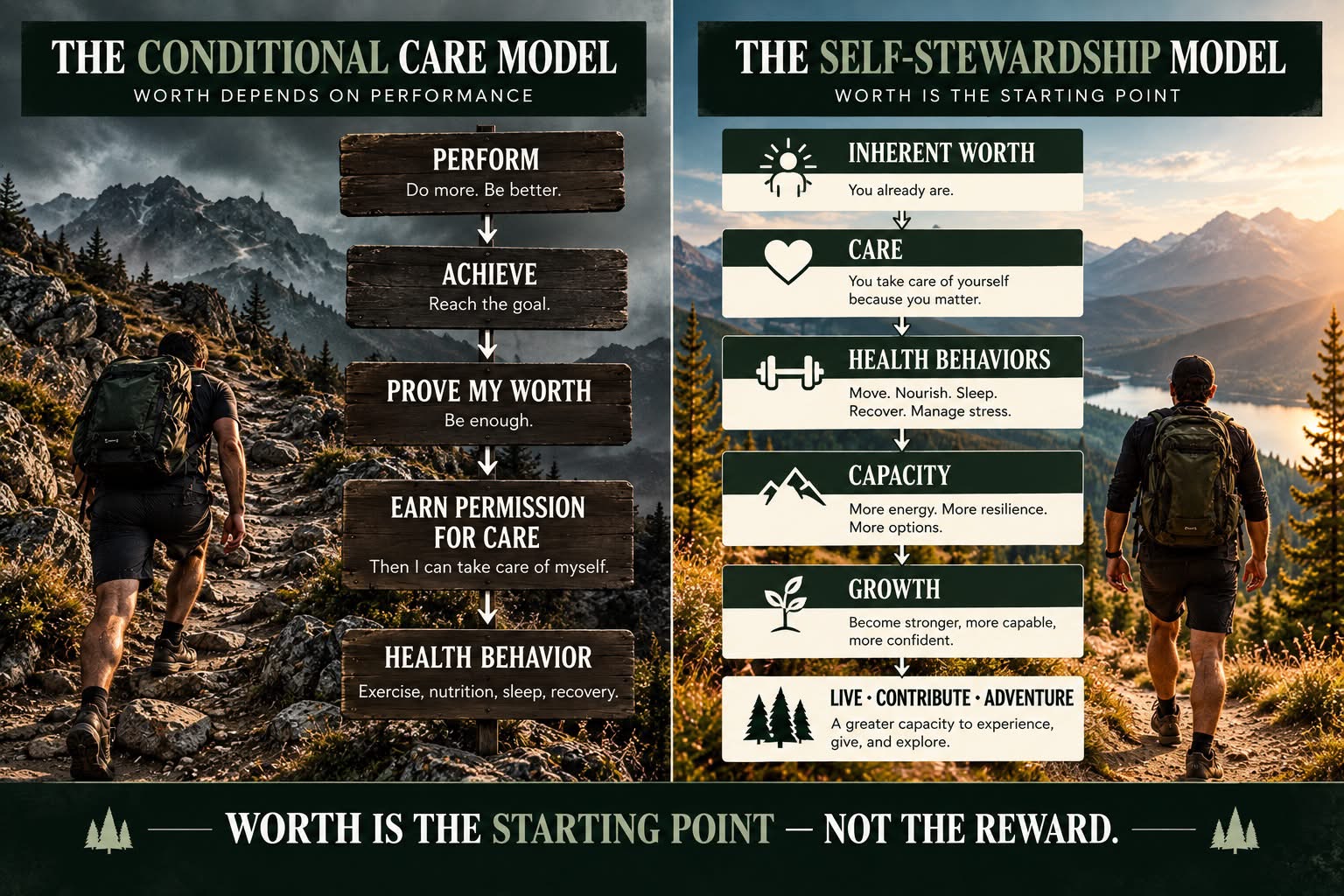
Many of us unconsciously operate from something resembling this:
THE CONDITIONAL CARE MODEL
PERFORM
↓
ACHIEVE
↓
PROVE MY WORTH
↓
EARN PERMISSION TO CARE FOR MYSELF
↓
HEALTH BEHAVIOR
There is a vulnerability built into this system.
When performance disappears, permission to care can disappear with it.
So we propose another model.
THE OUTSIDERS SELF-STEWARDSHIP MODEL
INHERENT WORTH
↓
CARE
↓
HEALTH BEHAVIORS
↓
CAPACITY
↓
GROWTH
↓
GREATER CAPACITY TO LIVE, CONTRIBUTE & ADVENTURE
Notice something important.
The arrow never circles back to worth.
You don’t complete a workout and become more worthy.
You don’t lose twenty pounds and become more worthy.
You don’t finish an ultramarathon and become more worthy.
You become more capable.
You may become healthier.
You may become stronger.
You may become more skilled.
You may become more resilient.
You may discover things about yourself that you could never have learned without the challenge.
Those things matter.
But they don’t have to determine your human value.
Worth remains at the beginning.
HEALTH AS AN EXPRESSION OF CARE
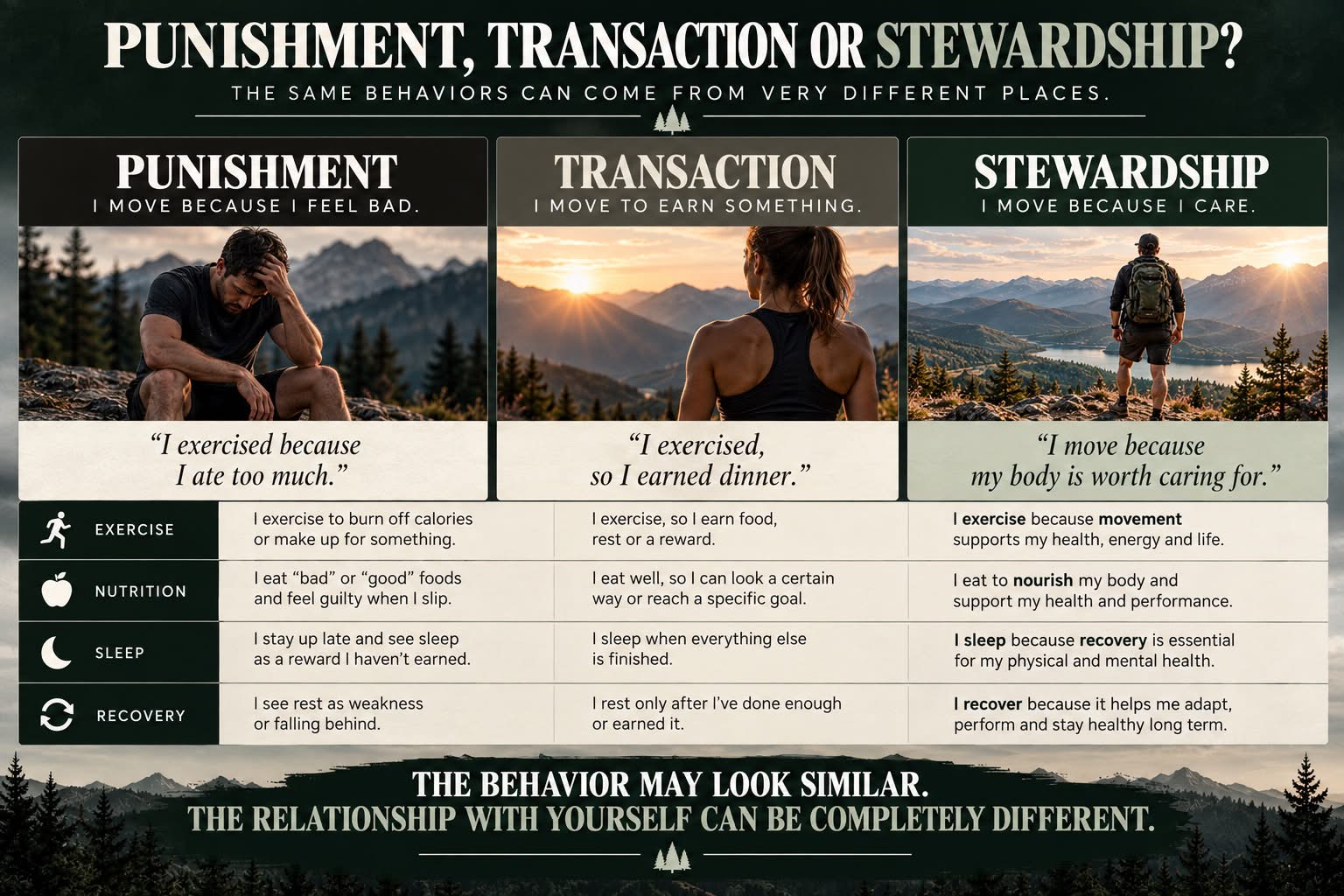
Once we change the starting point, familiar health behaviors can take on a completely different meaning.
Exercise
Instead of:
“I need to fix my body.”
Try:
“My body benefits from movement, and I am responsible for caring for it.”
Exercise becomes stewardship rather than punishment.
Nutrition
Instead of:
“I was bad yesterday, so I need to restrict today.”
Try:
“My body needs nutrients and energy today regardless of what happened yesterday.”
Food stops being a moral scoreboard.
It becomes nourishment.
Sleep
Instead of:
“I’ll sleep when everything is finished.”
Recognize an uncomfortable reality:
Everything may never be finished.
There will always be another email.
Another responsibility.
Another project.
Another problem.
Sleep isn’t the reward waiting at the bottom of a completed task list.
It is part of the biological infrastructure that allows you to function.
Recovery
Instead of:
“Rest means I’m falling behind.”
Try:
“Recovery is part of adaptation.”
Training creates a stimulus.
Recovery helps the organism respond to it.
Rest isn’t necessarily the opposite of training.
Sometimes it is part of training.
Medical Care
Instead of:
“It’s probably nothing.”
“I’ll wait.”
“I don’t have time.”
Consider:
“My health deserves attention before something becomes a crisis.”
Boundaries
Instead of:
“If I say no, I’m selfish.”
Try:
“My time, energy, and capacity are finite resources.”
You cannot say yes to everything.
Every yes consumes something.
Boundaries help determine where those finite resources go.
FOOD, EXERCISE, AND THE MORALIZATION OF THE BODY
Listen carefully to the language we use around food.
“I was good today.”
“I cheated.”
“I earned this.”
“I need to burn that off.”
Those aren’t merely nutritional statements.
They are moral language.
Food becomes virtue.
Exercise becomes penance.
The body becomes evidence.
But your lunch is not a confession.
And your workout is not absolution.
Research has found higher self-compassion associated with fewer body-image concerns and less eating pathology, as well as greater positive body image.
That does not mean nutrition goals or body-composition goals are inherently problematic.
You may legitimately want to lose weight.
Gain muscle.
Improve metabolic health.
Run faster.
Become stronger.
Change your eating habits.
The distinction lies partly in the meaning attached to the goal.
Compare:
“I hate my body, therefore I need to change it.”
with:
“This is my body, therefore I am going to care for it.”
The behavior might occasionally look similar.
The relationship with yourself is not.
WHAT HAPPENS WHEN YOU FALL SHORT?
You will.
That’s not pessimism.
That’s being human.
At some point you will miss the workout.
Eat differently than you intended.
Stay up too late.
Lose fitness.
Gain weight.
Become injured.
Lose motivation.
Experience stress.
Get sick.
Travel.
Become overwhelmed.
Fall out of your routine.
The question isn’t whether this will ever happen.
The more useful question is:
What happens next?
Research examining exercise setbacks has found greater self-compassion associated with less rumination and negative affect and with greater exercise-goal reengagement and more self-determined motivation. Because that research was cross-sectional, we should not claim self-compassion caused those outcomes.
But it raises a valuable possibility.
When something goes wrong, perhaps self-condemnation isn’t the most effective recovery strategy.
Imagine:
“I missed the entire week. I’m so lazy. I always do this.”
versus:
“I missed the week.”
“What happened?”
“What was within my control?”
“What wasn’t?”
“Does the plan need adjustment?”
“What can I learn?”
“What is the next reasonable action?”
This is not letting yourself off the hook.
It is putting yourself back on it.
Without the unnecessary detour through shame.
Correct the behavior without condemning the person.
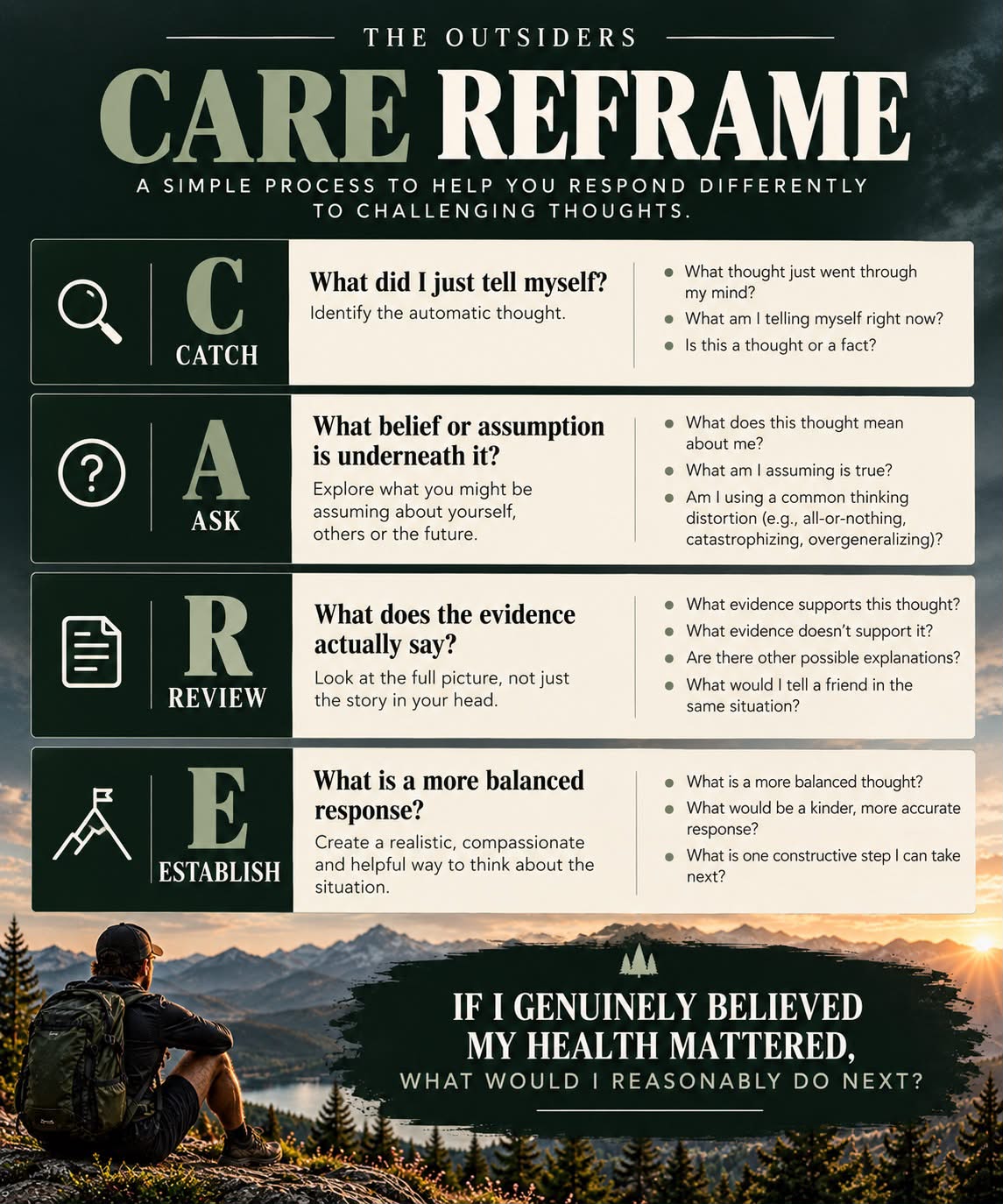
THE OUTSIDERS CARE REFRAME
Here is a practical way to begin applying cognitive restructuring to health.
C — CATCH THE THOUGHT
Notice what you just told yourself.
“I don’t deserve to rest.”
“I ruined everything.”
“I’m being selfish.”
“I should be doing more.”
“I look terrible.”
Don’t immediately fight the thought.
Notice it.
Write it down if necessary.
A — ASK WHAT’S UNDERNEATH IT
What are you assuming?
Take:
“I don’t deserve to rest.”
Perhaps underneath it is:
“Rest must be earned.”
Ask again:
Why?
“Because productive people keep going.”
Again:
Why does that matter?
Eventually you may discover:
“My value depends upon being productive.”
Now you’ve found something worth examining.
R — REVIEW THE EVIDENCE
Ask:
Is this objectively true?
What evidence supports it?
What evidence challenges it?
Am I confusing a feeling with a fact?
Am I turning one behavior into a judgment about my entire identity?
Would I apply this same standard to someone I care about?
Is there another reasonable interpretation?
The purpose isn’t to prove yourself wrong every time.
Sometimes the original thought contains useful information.
The purpose is to evaluate it rather than automatically obey it.
E — ESTABLISH A MORE BALANCED RESPONSE
Not:
“I’m perfect.”
Not:
“Everything is fine.”
Not:
“I deserve whatever I want.”
Instead:
“My productivity can matter without determining my worth. My body needs recovery, and appropriate recovery helps me function.”
Then ask one final question:
If I genuinely believed my health mattered, what would I reasonably do next?
Maybe you train.
Maybe you rest.
Maybe you cook dinner.
Maybe you go to bed.
Maybe you call the doctor.
Maybe you take a walk.
Maybe you say no.
Maybe you ask for help.
Maybe you apologize.
Maybe you restart the program.
Maybe you do the difficult thing you’ve been avoiding.
Cognitive restructuring isn’t supposed to end with a prettier thought.
It should help us see reality more clearly and respond more effectively.
FROM SELF-IMPROVEMENT TO SELF-STEWARDSHIP
There is nothing wrong with self-improvement.
We believe deeply in growth.
Become stronger.
Develop endurance.
Learn.
Train.
Improve your skills.
Challenge yourself.
Build resilience.
Accept responsibility.
Do difficult things.
Go somewhere you’ve never been.
Attempt something you aren’t entirely sure you can accomplish.
Discover what happens when the person you are today meets meaningful adversity.
But there is another way to frame this process.
Instead of constantly asking:
“How do I fix myself?”
occasionally ask:
“How do I take responsibility for caring for the person I’ve been given?”
That is self-stewardship.
Self-improvement can sometimes begin with:
I am inadequate → therefore I must become better.
Self-stewardship begins somewhere else:
I have value → therefore I have something worth developing, protecting, challenging, and caring for.
Growth remains.
Standards remain.
Discipline remains.
Responsibility remains.
Difficulty remains.
But self-rejection no longer has to provide the fuel.
WHEN HEALTH STARTS TO FEEL NATURAL
At first, this may require deliberate thought.
“I am allowed to take this hour.”
“My health matters too.”
“Rest doesn’t need to be earned.”
“My needs aren’t automatically less important.”
That is cognitive restructuring.
But ideally, you don’t spend the next forty years having the same argument every morning.
Eventually something begins to change.
Exercise becomes something you do.
Sleep becomes something you protect.
Food becomes something that supports you.
Recovery becomes normal.
Medical care becomes responsible.
Boundaries become understandable.
The internal negotiation becomes quieter.
And eventually the statement changes from:
“Am I allowed to take care of myself?”
to:
“OF COURSE I TAKE CARE OF MYSELF.”
Not arrogantly.
Not obsessively.
Not at everyone else’s expense.
Not because you believe you are more important.
Because:
You are included among the people whose wellbeing matters.

CARE DOES NOT MEAN COMFORT
There is one final distinction we need to make.
Caring for yourself does not mean making your life easy.
Sometimes care means rest.
Sometimes care means getting out of bed.
Sometimes care means saying no.
Sometimes it means keeping a commitment when you’d rather quit.
Sometimes care means reducing the weight.
Sometimes it means adding another plate.
Sometimes it means recovery.
Sometimes it means discomfort.
Sometimes it means walking away.
Sometimes it means staying and doing the work.
Sometimes it means accepting your limits.
And sometimes it means discovering that the limits you believed were permanent were only the edge of your current capacity.
Care is not synonymous with comfort.
Care means acting in service of wellbeing rather than acting from contempt for yourself.
That difference matters.
YOU DON’T HAVE TO EARN YOUR WAY BACK
You don’t have to punish yourself for Monday before exercising Tuesday.
You don’t have to compensate for dinner before eating breakfast.
You don’t have to become fit before entering the gym.
You don’t have to become productive before sleeping.
You don’t have to reach your goal weight before respecting your body.
You don’t have to finish the race before being proud that you started.
You don’t have to accomplish something extraordinary before deciding that your health matters.
And when you fall away from the behaviors that support you, you don’t have to earn your way back.
You can simply begin again.
The next meal.
The next walk.
The next workout.
The next bedtime.
The next appointment.
The next decision.
Not because yesterday didn’t matter.
But because today still does.
THE OUTSIDERS PRINCIPLE
We are not saying:
“You are worthy, therefore don’t change.”
We are saying:
You are worthy, therefore your health is worth protecting.
Move your body.
Challenge yourself.
Become stronger.
Eat well.
Sleep.
Recover.
Go outside.
See your physician.
Set boundaries.
Ask for help.
Learn something difficult.
Train for something that scares you a little.
Walk farther than you thought you could.
Climb the mountain.
Become capable of things your previous self couldn’t yet do.
Explore.
Struggle.
Grow.
Become more.
But don’t do those things because you’re desperately trying to turn yourself into someone who finally deserves care.
Begin from worth.
Then build from there.
YOU WERE WORTHY BEFORE YOU GOT HEALTHY
You were worthy before the weight came off.
You were worthy before you became strong.
You were worthy before the promotion.
You were worthy before the race.
You were worthy before anyone applauded.
You were worthy on the days you performed beautifully.
You were worthy on the days nobody noticed.
And you were still worthy on the days you struggled.
Your health was never supposed to be the entrance fee for becoming valuable.
Your health is something worth protecting because you already are.
So perhaps the next time you exercise, you don’t have to do it because something is wrong with you.
Move because your body is worth moving.
Perhaps the next time you choose nutritious food, you don’t have to do it because yesterday made you “bad.”
Eat because your body is worth nourishing.
Perhaps tonight you don’t have to earn your sleep.
Sleep because your body is worth recovering.
Perhaps the next time you need help, you don’t have to prove that you’ve exhausted every other possibility first.
Ask because your wellbeing matters too.
And perhaps one day, taking care of yourself will no longer feel like an indulgence that requires justification.
It will simply feel natural.
Of course I take care of myself.
Because somewhere along the way, you stopped asking your accomplishments for permission to matter.
CARE IS NOT SOMETHING YOU EARN.
You don’t become worthy by taking care of yourself.
You take care of yourself because you already are.
The Outsiders Bootcamp
REFERENCES & RESEARCH FOUNDATION
The ideas presented in this article draw from research in cognitive behavioral therapy, cognitive restructuring, contingencies of self-worth, self-compassion, health behavior, exercise psychology, eating and body image, and self-regulation.
An important distinction runs throughout the article: psychological research can examine self-esteem, self-compassion, cognition, behavior, motivation, stress, and health outcomes. The proposition that every human being possesses inherent worth independent of achievement is a philosophical premise of the Outsiders Self-Stewardship framework rather than an empirical claim that science can prove.
COGNITIVE BEHAVIORAL THERAPY & COGNITIVE RESTRUCTURING
American Psychological Association. Handbook of Cognitive Behavioral Therapy.
The APA describes cognitive restructuring as a core strategy in cognitive behavioral treatment involving the identification, evaluation, and, when appropriate, modification of unhelpful thinking. The cognitive model also distinguishes situation-specific automatic thoughts from deeper core beliefs about oneself, others, the world, and the future.
This research foundation supports the article’s discussion of:
-
Automatic thoughts
-
Core beliefs
-
Cognitive distortions
-
Examining evidence
-
Developing more balanced interpretations
-
The distinction between an event and our interpretation of that event
American Psychological Association. APA Dictionary of Psychology: Cognitive Therapy.
The APA describes cognitive therapy as identifying maladaptive patterns of thought and developing more adaptive interpretations through cognitive restructuring.
Beck Institute for Cognitive Behavior Therapy. Thought Record Worksheet.
The Beck Institute’s thought-record approach includes examining evidence supporting and contradicting an automatic thought, considering alternative explanations, evaluating realistic outcomes, considering what one might tell another person in the same situation, and identifying an appropriate behavioral response.
These principles helped inform the Outsiders CARE Reframe presented in this article.
CONTINGENCIES OF SELF-WORTH
Crocker, J., & Wolfe, C. T. (2001). Contingencies of self-worth. Psychological Review, 108(3), 593–623.
https://doi.org/10.1037/0033-295X.108.3.593
Crocker and Wolfe proposed that self-esteem can rise and fall in response to successes and failures within domains upon which individuals have staked their self-worth.
This model provides an important research foundation for the article’s discussion of conditional worth—particularly the distinction between:
“Success matters to me.”
and
“My success determines what I am worth.”
Crocker, J., Luhtanen, R. K., Cooper, M. L., & Bouvrette, A. (2003). Contingencies of self-worth in college students: Theory and measurement. Journal of Personality and Social Psychology, 85(5), 894–908.
https://doi.org/10.1037/0022-3514.85.5.894
This research identified several domains upon which people may base self-esteem, including appearance, approval from others, competition, academics, family support, virtue, and religiously framed sources of worth.
Crocker, J., Brook, A. T., Niiya, Y., & Villacorta, M. (2006). The pursuit of self-esteem: Contingencies of self-worth and self-regulation. Journal of Personality, 74(6), 1749–1771.
https://doi.org/10.1111/j.1467-6494.2006.00427.x
The authors describe an important paradox: contingent self-worth can strongly motivate achievement, yet protecting or enhancing self-esteem can sometimes interfere with effective self-regulation, particularly when tasks become difficult and failure is possible.
This distinction informs one of the central ideas of the article:
Achievement can matter without determining human worth.
SELF-COMPASSION, PHYSICAL HEALTH & HEALTH BEHAVIOR
Phillips, W. J., & Hine, D. W. (2021). Self-compassion, physical health, and health behaviour: A meta-analysis. Health Psychology Review, 15(1), 113–139.
https://doi.org/10.1080/17437199.2019.1705872
This meta-analysis included 94 peer-reviewed articles and a pooled sample of 29,588 participants.
Self-compassion was positively associated with physical health (r = .18) and health-promoting behavior (r = .26).
Associations varied across health domains, with notable relationships involving areas including sleep, composite health behavior, global physical health, and danger avoidance.
Multi-session interventions designed to increase self-compassion were associated with improvements in physical health and health behavior, while single-session inductions were not significant.
This research supports the article’s broader proposition that treating oneself compassionately is not inherently incompatible with responsible health behavior.
SELF-COMPASSION, STRESS & HEALTH BEHAVIOR
Self-compassion, stress and health behaviour: A systematic review and meta-analysis (2026).
This systematic review and meta-analysis included 19 studies with a combined sample of 9,660 adults.
The analysis found:
-
Self-compassion and health-promoting behavior: r = .23
-
Self-compassion and health-risk behavior: r = –.19
-
Self-compassion and stress: r = –.51
Stress partially mediated the relationships between self-compassion and health-promoting and health-risk behaviors.
The findings provide additional evidence for a relationship among self-compassion, stress regulation, and health behavior.
SELF-COMPASSION & EVERYDAY HEALTH BEHAVIORS
Sirois, F. M., Kitner, R., & Hirsch, J. K. (2015). Self-compassion, affect, and health-promoting behaviors. Health Psychology, 34(6), 661–669.
https://doi.org/10.1037/hea0000158
Across 15 independent samples involving 3,252 participants, self-compassion was positively associated with self-reported health-promoting behaviors.
Behaviors examined included:
-
Eating habits
-
Exercise
-
Sleep behavior
-
Stress management
This work contributes to the research foundation behind the article’s discussion of approaching health behavior through care rather than self-condemnation.
SELF-COMPASSION & MOTIVATION TO IMPROVE
Breines, J. G., & Chen, S. (2012). Self-compassion increases self-improvement motivation. Personality and Social Psychology Bulletin, 38(9), 1133–1143.
https://doi.org/10.1177/0146167212445599
Across four experiments, researchers examined whether responding compassionately to mistakes, weaknesses, or failures undermined or enhanced motivation for improvement.
Self-compassion was associated with outcomes including greater motivation to address personal weaknesses, greater motivation to avoid repeating a moral transgression, and more time spent studying following an initial test failure.
This research is particularly relevant to a common fear addressed in the article:
“If I stop criticizing myself, won’t I become complacent?”
The evidence suggests that self-compassion and self-improvement motivation do not have to be opposites.
This supports the article’s distinction:
Self-compassion does not have to mean:
“Nothing needs to change.”
It can mean:
“I don’t have to hate myself in order to change.”
SELF-COMPASSION & EXERCISE SETBACKS
Semenchuk, B. N., Strachan, S. M., & Fortier, M. (2018). Self-compassion and the self-regulation of exercise: Reactions to recalled exercise setbacks. Journal of Sport & Exercise Psychology, 40(1), 31–39.
https://doi.org/10.1123/jsep.2017-0242
This cross-sectional study examined 105 adults who had experienced an exercise setback during the previous six months.
Greater self-compassion was associated with:
-
Greater exercise-goal reengagement
-
More self-determined motivation
-
Less state rumination
-
Less negative affect
-
Lower extrinsic motivation
Because the study was cross-sectional, these findings should not be interpreted as demonstrating that self-compassion caused these outcomes.
They nevertheless provide useful evidence regarding the relationship between self-compassion and how people respond psychologically to exercise setbacks.
This research helped inform one of the article’s central practical principles:
Correct the behavior without condemning the person.
SELF-COMPASSION, BODY IMAGE & EATING BEHAVIOR
Turk, F., & Waller, G. (2020). Is self-compassion relevant to the pathology and treatment of eating and body image concerns? A systematic review and meta-analysis. Clinical Psychology Review, 79, 101856.
https://doi.org/10.1016/j.cpr.2020.101856
This systematic review and meta-analysis included 59 studies.
Higher self-compassion was associated with:
-
Lower eating pathology: r = –.34
-
Lower body-image concerns: r = –.45
-
Greater positive body image: r = .52
Self-compassion interventions also demonstrated beneficial effects compared with control conditions for eating pathology and body-image outcomes.
This research supports the article’s discussion of separating food, exercise, and body composition from judgments about personal morality or human value.
SELF-COMPASSION & MEDICAL ADHERENCE
Sirois, F. M., & Hirsch, J. K. (2019). Self-compassion and adherence in five medical samples: The role of stress. Mindfulness, 10(1), 46–54.
https://doi.org/10.1007/s12671-018-0945-9
This research examined relationships among self-compassion, perceived stress, and medical adherence across five medical populations.
The work contributes to a broader research literature investigating whether a more compassionate relationship with oneself may support rather than undermine responsible health behavior.
AN IMPORTANT DISTINCTION: RESEARCH VS. PHILOSOPHY
The scientific literature cited above provides evidence concerning:
-
Cognitive restructuring
-
Automatic thoughts and core beliefs
-
Contingencies of self-worth
-
Self-compassion
-
Health-promoting behavior
-
Stress
-
Exercise self-regulation
-
Responses to setbacks
-
Eating behavior
-
Body image
-
Motivation for self-improvement
It does not scientifically establish that:
“Every human being possesses inherent worth.”
Human worth is not a biological variable that can be measured in a laboratory.
The Outsiders Self-Stewardship Model therefore begins with an explicitly stated philosophical premise:
HUMAN WORTH DOES NOT HAVE TO BE EARNED THROUGH PERFORMANCE.
From that premise, we ask a practical question:
What might change if health were approached not as a way to prove our value, but as one way of caring for a life we already consider valuable?
That question leads to the model proposed in this article:
THE OUTSIDERS SELF-STEWARDSHIP MODEL
INHERENT WORTH
↓
CARE
↓
HEALTH BEHAVIORS
↓
CAPACITY
↓
GROWTH
↓
GREATER CAPACITY TO LIVE, CONTRIBUTE & ADVENTURE
The Outsiders Self-Stewardship Model and Outsiders CARE Reframe are conceptual frameworks developed for this article. They should not be interpreted as established clinical instruments or validated psychological treatments.
They are intended to translate principles from cognitive restructuring, self-compassion, self-regulation, and the Outsiders philosophy into an accessible framework for thinking about health.
EDUCATIONAL DISCLAIMER
This article is intended for general educational purposes and is not a substitute for individualized medical or mental-health care.
Cognitive restructuring is an established technique used within cognitive behavioral therapy. Individuals experiencing significant depression, anxiety, disordered eating, trauma, persistent feelings of worthlessness, or other mental-health concerns may benefit from working with an appropriately qualified mental-health professional.
THE OUTSIDERS PRINCIPLE
CARE IS NOT SOMETHING YOU EARN.
You don’t become worthy by taking care of yourself.
You take care of yourself because you already are.
The Outsiders Bootcamp
Stay connected with news and updates!
Join our mailing list to receive the latest news and updates from our team. Don't worry, your information will not be shared.
We hate SPAM. We will never sell your information, for any reason.
