
The Outsiders Guide to Choosing the Right Mattress
Sep 01, 2026
HOW TO CHOOSE A MATTRESS FOR YOUR BODY, SLEEPING POSITION, AND RECOVERY
We spend roughly one-third of our lives sleeping.
For those of us who train, hike, run, lift, work hard, and expect our bodies to perform, those hours aren’t simply time when we’re doing nothing. They’re part of recovery.
The American Academy of Sleep Medicine recommends that adults regularly get at least seven hours of sleep, and its expert consensus considered seven to nine hours appropriate for supporting optimal adult health.
Think about how much attention we give everything else. We buy shoes based on how we move. We adjust training volume according to our abilities. We work on mobility. We strength train. We pay attention to nutrition. We think about hydration. We modify exercises when our mechanics aren’t right.
And then we spend seven or eight hours every night lying on a surface many of us selected by walking into a store, pushing our hand into several mattresses, lying on one for thirty seconds, and deciding: “This one feels pretty comfortable.”
There has to be a better way. There is.
You don’t need an engineering degree. You don’t need to understand every type of foam. And you don’t need to blindly trust a mattress company’s recommendation that everyone who sleeps on their side needs the same mattress.
You need:
- A scale
- A flexible tape measure
- About five minutes
- An understanding of how you actually sleep
- Some very basic math
From that information, we’re going to determine what your body likely requires from a mattress. Then we’re going to show you how to test it.
THE FIRST RULE: THERE IS NO PERFECT FIRMNESS FOR EVERYONE
You’ve probably seen recommendations like: Side sleeper? Buy a soft mattress. Back sleeper? Buy medium-firm. Stomach sleeper? Buy firm.
That’s a reasonable place to begin. It’s a terrible place to stop.
Consider two side sleepers. One weighs 120 pounds. The other weighs 280 pounds. Even if they lie on exactly the same mattress, they don’t experience the same mattress. The heavier sleeper places substantially greater load into the mattress and compresses its layers farther.
Now consider two people who both weigh 200 pounds. One has very broad shoulders and a narrow waist. The other has relatively similar shoulder, waist, and hip dimensions. They don’t require exactly the same mattress either.
That’s because mattress selection isn’t simply about firmness. It is about the interaction between your body, your sleeping position, and the mattress.
Research supports the general concept. Systematic reviews have generally found medium-firm mattresses perform favorably for comfort, sleep quality, spinal alignment, and nonspecific low-back symptoms, while also emphasizing individual anthropometrics, sleeping posture, pressure distribution, and customization.
So we’re going to start near the middle. Then we’re going to personalize from there.
CONTENTS
START HERE
UNDERSTANDING THE BASICS
CALCULATE YOUR PERSONAL NUMBERS
- The Outsiders Mattress Fit Calculator
- Calculate Deep Support
- Do You Need Zoning?
- Your Outsiders Mattress Profile
TURN YOUR NUMBERS INTO A MATTRESS
- Match Your Numbers to Mattress Construction
- Mattress Materials
- Don’t Fall for Mattress Marketing
- Apply Your Personal Filters
- Don’t Forget Your Pillow
TEST & VERIFY
- The Outsiders 15-Minute Mattress Test
- Your Mattress Scorecard
- The Outsiders Mattress Decision Hierarchy
- Use the Home Trial
FINALIZE YOUR PROFILE
CHOOSE THE ACTUAL MATTRESS
- From Your Score to an Actual Mattress
- Customizable Mattresses
- When Customization Makes Sense
- The Mattress Match Card
- Why We Recommended It
- Why We Might NOT Recommend a Popular Mattress
SUPPORTING SYSTEMS & LONGEVITY
- Mattress + Foundation + Pillow
- When Should You Replace Your Mattress?
- Worked Examples
- The Outsiders Mattress Shortlist
- The Final Rule
- Manufacturer Firmness Is Not Our Firmness
RECOMMENDATIONS & CLOSING
- Mattress Recommendations by Outsiders Profile
- Sources & Methodology
- Conclusion — Your Mattress Is Part of Your Recovery Environment
START HERE
QUICK START — FIND YOUR MATTRESS PROFILE
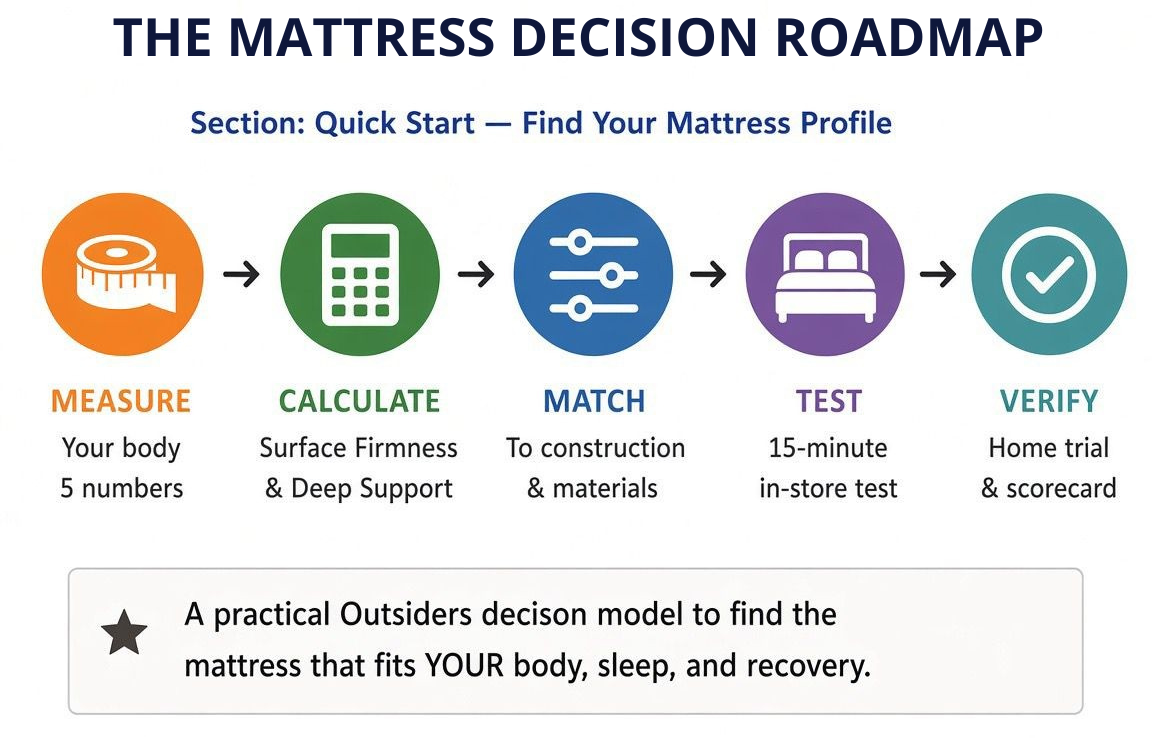
This guide is intentionally thorough. But you do not need to memorize everything in it to use the system. If you want to get started immediately, follow these eight steps.
STEP 1 — MEASURE YOURSELF
You will need:
- Body weight
- Height
- Shoulder circumference
- Waist circumference
- Hip circumference
These measurements help us estimate how much load you place on the mattress and how much accommodation your shoulders and hips may require.
STEP 2 — ESTIMATE HOW YOU ACTUALLY SLEEP
Estimate the percentage of the night you spend:
Side: ____% Back: ____% Stomach: ____% Total: 100%
Do not simply identify yourself as a “side sleeper” if you actually spend a significant portion of the night on your back. Your mattress needs to work across the positions you actually use.
STEP 3 — CALCULATE YOUR SURFACE FIRMNESS RANGE
Use the Outsiders Surface Firmness Formula in this guide. It considers body weight, sleeping position, body contour, and pressure sensitivity. The result gives you a starting range, not an exact prescription.
Example
Surface Firmness Target: 5–6
STEP 4 — CALCULATE YOUR DEEP SUPPORT REQUIREMENT
Calculate how much underlying resistance your body is likely to require. This is different from surface firmness.
Example
Surface Firmness: 5–6
Deep Support: 7–8
An accommodating surface over a stronger foundation.
STEP 5 — DETERMINE YOUR ZONING NEED
Your shoulder, waist, and pelvis do not necessarily require the same amount of mattress resistance. Your measurements help determine whether you may benefit from Minimal, Low, Moderate, High, or Very High zoning.
Side-sleeper rule
SHOULDER — YIELD
WAIST — SUPPORT
PELVIS — YIELD, THEN STOP
STEP 6 — FIND YOUR OUTSIDERS PROFILE
- Profile A — Light & Accommodating
- Profile B — Accommodating Surface + Strong Foundation
- Profile C — Balanced
- Profile D — Responsive Athletic
- Profile E — Firm Surface + High Support
- Profile F — Customizable / Complex
Use your profile to eliminate mattresses that clearly do not fit your requirements.
STEP 7 — CHOOSE THREE MATTRESSES
Do not compare twenty mattresses. Start with three:
- Mattress 1 — Conventional Match
- Mattress 2 — Different Construction
- Mattress 3 — Customizable Option, when appropriate
A customizable option is especially useful for unusual body proportions, High or Very High zoning requirements, substantially different partner needs, previous selection failures, or significant uncertainty about firmness.
STEP 8 — VERIFY
Never buy solely from the calculator. Use the Outsiders 15-Minute Mattress Test followed by the Home Trial.
MEASURE → CALCULATE → MATCH → TEST → VERIFY
UNDERSTANDING THE BASICS
HOW A MATTRESS ACTUALLY WORKS
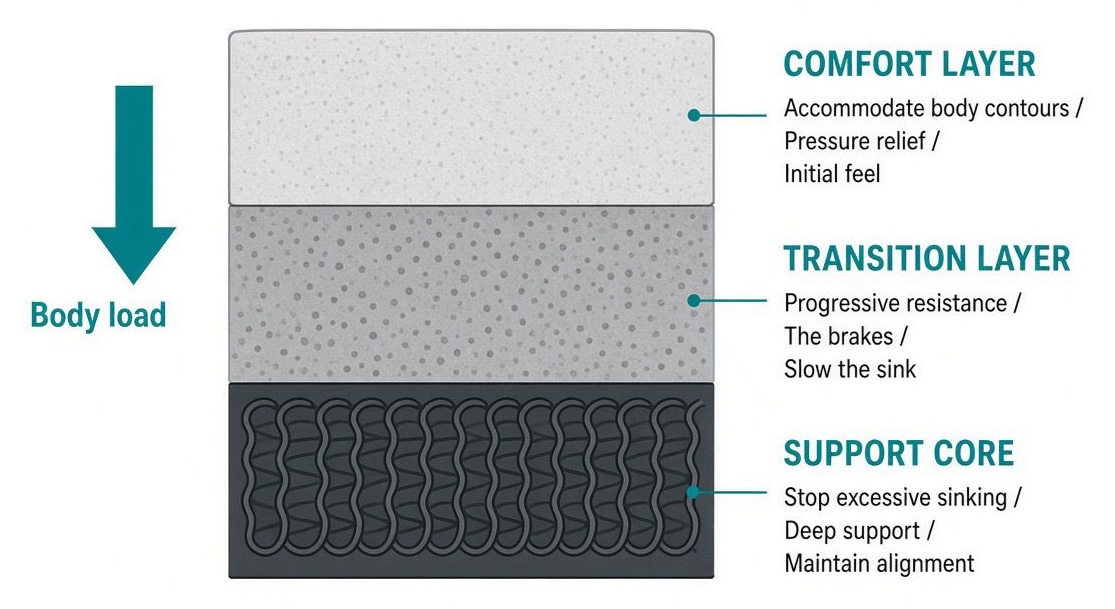
Forget mattress brands for a moment. Most mattresses can be understood as three functional systems:
|
COMFORT |
THE COMFORT LAYER
This is the portion closest to your body. Its job is primarily to:
- Accommodate your body’s contours
- Allow prominent areas to penetrate
- Redistribute pressure
- Create the initial feel of the mattress
For a side sleeper, the shoulder and hip need somewhere to go. If the surface doesn’t yield sufficiently, those structures remain elevated. That can increase pressure and affect positioning. But making the entire mattress extremely soft isn’t necessarily the answer, because something else needs to happen as you sink farther.
THE TRANSITION LAYER
Think of the transition layer as the brakes. The comfort layer says: Come in. The transition layer says: Slow down. It progressively increases resistance before you reach the underlying support structure.
A mattress can therefore have a relatively soft, pressure-relieving surface without allowing your pelvis to disappear deeply into the bed.
THE SUPPORT CORE
Eventually the mattress needs to say: Stop. That’s the support core. It may consist of:
- Pocketed coils
- Foam
- Latex
- Air chambers
- Other spring systems
Its job isn’t primarily to make the mattress feel hard. Its job is to manage deeper loading and prevent inappropriate displacement.
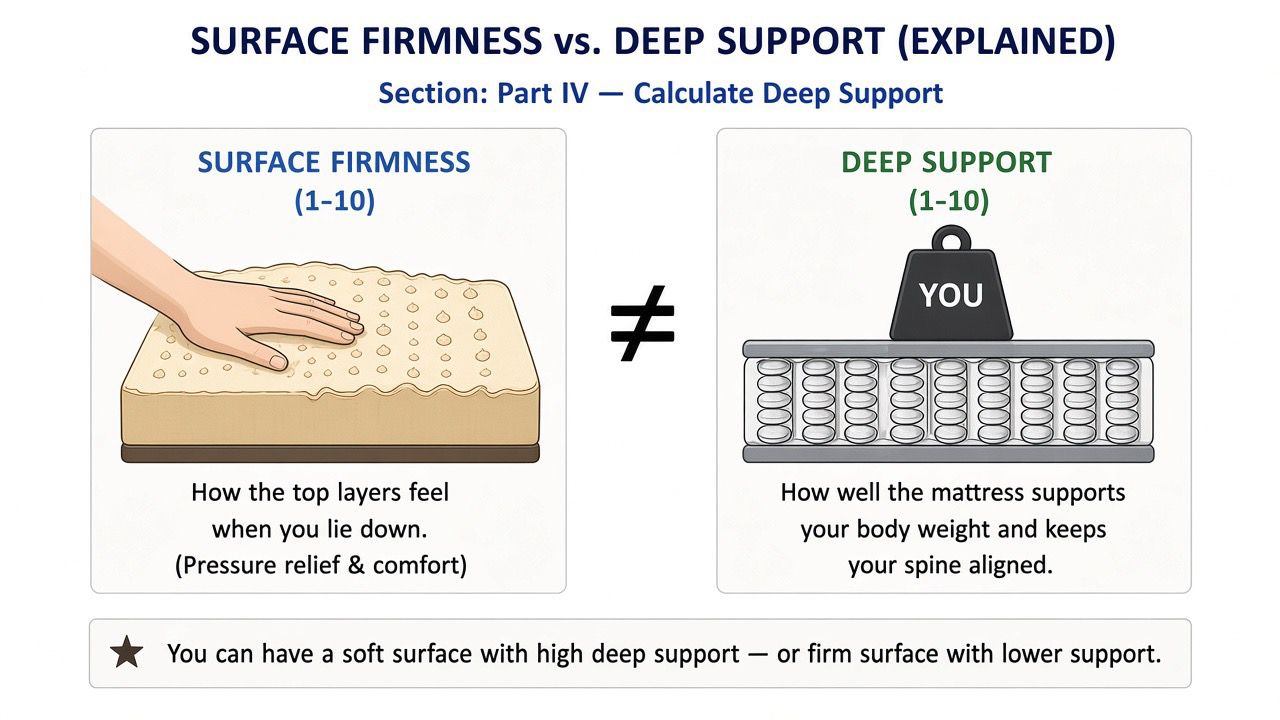
FIRMNESS IS NOT SUPPORT
|
An accommodating surface + excellent support can coexist. |
FOUR THINGS A MATTRESS MUST DO
Firmness
How resistant the surface initially feels.
Conformability
How effectively the mattress accommodates your body’s contours.
Pressure Relief
How effectively load is distributed across the contact area.
Support
How effectively the mattress prevents inappropriate displacement as you sink farther.
All four contribute to the outcome we’re ultimately interested in: alignment. Mattress biomechanics research commonly evaluates spinal alignment and pressure distribution, but there are not yet universally validated numerical thresholds defining the perfect alignment or pressure distribution for every sleeper.
THE THREE JOBS OF A MATTRESS
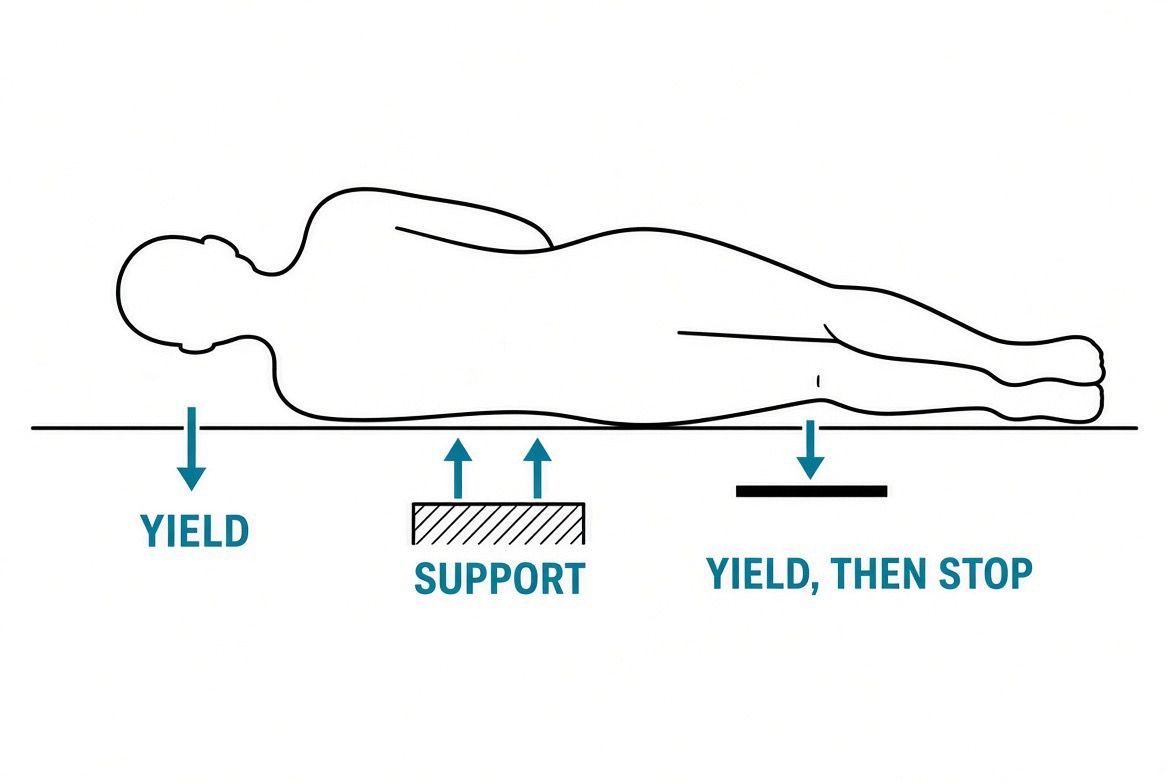
|
YIELD |
WHY SLEEPING POSITION CHANGES EVERYTHING
SIDE SLEEPING
Side sleeping creates one of the most challenging shapes for a mattress. Viewed from behind, your shoulder and hip project outward considerably farther than your waist.
If the mattress is too firm:
- Shoulder penetration may be inadequate
- Hip penetration may be inadequate
- Pressure can increase
- The waist may be poorly supported
- The spine can deviate laterally
If the mattress is too soft or poorly supported:
- The pelvis can descend excessively
- The trunk can follow
- Repositioning can become difficult
- Alignment can deteriorate in the opposite direction
|
The objective is not SOFT. |
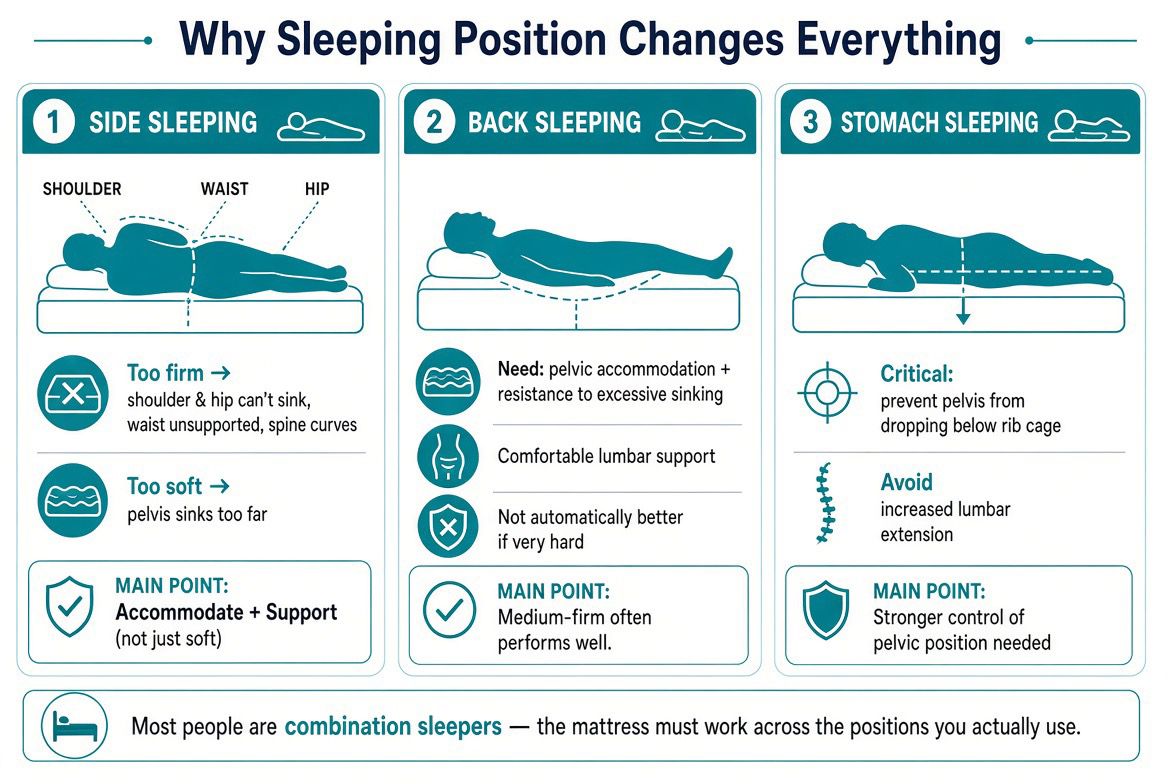
BACK SLEEPING
Back sleeping creates different requirements. We generally want:
- Appropriate pelvic accommodation
- Resistance against excessive pelvic sinking
- Comfortable lumbar support
- Thoracic accommodation
- Appropriate head and neck positioning
A very hard surface isn’t automatically better. A randomized controlled trial involving adults with chronic nonspecific low-back pain found better outcomes with medium-firm mattresses than firm mattresses.
STOMACH SLEEPING
Stomach sleeping presents another problem. The pelvis cannot be allowed to descend dramatically relative to the rib cage. If it does, lumbar extension can increase. Research on sleeping posture suggests prone sleeping can place greater strain on the lumbar region than supportive side lying or supine positions.
COMBINATION SLEEPING
Most people aren’t statues. If you spend 70% of the night on your side and 30% on your back, we should not pretend you’re simply a “side sleeper.” Our calculator accounts for that.
CALCULATE YOUR PERSONAL NUMBERS
THE OUTSIDERS MATTRESS FIT CALCULATOR
The relationships behind this model—body size, sleeping posture, pressure distribution, mattress stiffness, and spinal alignment—are supported by mattress biomechanics research. The exact coefficients in the calculator below are an Outsiders consumer model. They have not been clinically validated as a diagnostic or medical prescription. We are intentionally producing a range, not a magical perfect number.
STEP 1 — GATHER YOUR MEASUREMENTS
- Weight: ______ lb
- Height: ______ inches
- Shoulder Circumference: ______ inches
- Waist Circumference: ______ inches
- Hip Circumference: ______ inches
Measure shoulders around the broadest part of the shoulders/upper torso. Measure the waist around approximately navel level while relaxed. Measure hips around the widest part of the hips/buttocks.
STEP 2 — ESTIMATE HOW YOU SLEEP
Your percentages should total 100%.
Side: _____% Back: _____% Stomach: _____%
Do not overthink it. Estimate your typical night.
STEP 3 — START AT 6
|
Starting Surface Firmness = 6.0 / 10 |
Why? Because medium to medium-firm mattresses represent a defensible population-level starting point based on the available literature. We are going to personalize from there.
STEP 4 — CALCULATE YOUR WEIGHT ADJUSTMENT
(Your Weight − 175) ÷ 100
|
Weight |
Adjustment |
|
125 lb |
−0.50 |
|
175 lb |
0 |
|
225 lb |
+0.50 |
|
275 lb |
+1.00 |
Every 50 pounds above 175 adds approximately 0.5. Every 50 pounds below 175 subtracts approximately 0.5. For our model, cap this adjustment between approximately −1.25 and +1.50.
Weight Adjustment = ______
STEP 5 — CALCULATE SLEEP-POSITION ADJUSTMENT
|
Position |
Adjustment |
|
Side |
−0.50 |
|
Back |
0 |
|
Stomach |
+0.50 |
If you sleep in multiple positions, multiply each adjustment by the percentage of time spent there.
Example
70% side: 0.70 × −0.50 = −0.35
30% back: 0.30 × 0 = 0
Total Position Adjustment = −0.35
Position Adjustment = ______
STEP 6 — CALCULATE YOUR BODY CONTOUR
Shoulder Contour = (Shoulders − Waist) ÷ Waist × 100
Hip Contour = (Hips − Waist) ÷ Waist × 100
Example: Shoulders = 48", Waist = 34" → (48 − 34) ÷ 34 × 100 = 41% Shoulder Contour.
Shoulder Contour = ______% Hip Contour = ______%
Use whichever is larger. If either calculation is negative, treat that contour as 0% for the purpose of this model.
STEP 7 — FIND YOUR CONTOUR ADJUSTMENT
|
Largest Contour |
Adjustment |
|
Under 5% |
0 |
|
5–10% |
−0.10 |
|
11–20% |
−0.25 |
|
21–30% |
−0.35 |
|
31%+ |
−0.50 |
Then multiply that adjustment by your percentage of side sleeping. Example: −0.50 contour adjustment × 80% side sleeping = −0.40.
Contour Adjustment = ______
Why only apply it substantially to side sleeping? Because shoulder-to-waist and hip-to-waist differences create their greatest mattress-accommodation challenge while lying laterally.
STEP 8 — PRESSURE ADJUSTMENT
Ask: When lying in my normal sleeping position, do I commonly experience uncomfortable pressure at my shoulder, ribs, hip, or other contact points that makes me want to reposition?
|
Frequency |
Adjustment |
|
Rarely/Never |
0 |
|
Sometimes |
−0.25 |
|
Frequently |
−0.50 |
Pressure Adjustment = ______
Persistent pain, numbness, weakness, or neurological symptoms should not simply be attributed to a mattress. Those deserve appropriate medical evaluation.
STEP 9 — CALCULATE YOUR FIRMNESS
|
Surface Firmness Score = 6 + Weight Adjustment + Position Adjustment + Contour Adjustment + Pressure Adjustment |
|
Component |
Example |
|
Starting Point |
6.00 |
|
Weight Adjustment |
+0.45 |
|
Position Adjustment |
−0.40 |
|
Contour Adjustment |
−0.40 |
|
Pressure Adjustment |
+0.00 |
|
Surface Firmness Score |
= 5.65 |
Target approximately: 5.5–6
Begin testing approximately: 5–6.5
Because mattress firmness scales are not standardized between manufacturers, do not go shopping for a mythical “5.65 mattress.” This number is a starting point designed to dramatically narrow your search. The equation gets you into the neighborhood. Your body confirms the address.
CALCULATE DEEP SUPPORT
Now forget surface feel for a moment. We are asking: Once my body begins compressing the mattress, how much underlying resistance do I require?
|
Deep Support starts at 5. |
WEIGHT/LOAD ADJUSTMENT
(Weight − 175) ÷ 50
|
Weight |
Adjustment |
|
125 lb |
−1 |
|
175 lb |
0 |
|
225 lb |
+1 |
|
275 lb |
+2 |
|
325 lb |
+3 |
For our model, cap this adjustment around −2 to +3.
CENTRAL LOAD RATIO
Waist ÷ Hips
|
Waist/Hip Ratio |
Adjustment |
|
Under .85 |
0 |
|
.85–.94 |
+.25 |
|
.95–1.04 |
+.50 |
|
1.05+ |
+.75 |
This is a simple proxy for central load distribution—not a direct measurement of mass.
POSITION SUPPORT ADJUSTMENT
|
Position |
Deep Support Adjustment |
|
Side |
+.25 |
|
Back |
+.50 |
|
Stomach |
+1.00 |
Combination sleepers multiply each by the percentage of time spent in that position and add the results.
YOUR DEEP SUPPORT SCORE
|
Deep Support = 5 + Weight Load + Central Load + Position Support |
|
Score |
Requirement |
|
Under 4 |
Light |
|
4–5 |
Moderate |
|
5–6 |
Moderate-High |
|
6–7 |
High |
|
7–8 |
Very High |
|
8+ |
Exceptional |
|
Surface Firmness: 5.5 |
This is exactly why “soft, medium, or firm?” is not enough information.
DO YOU NEED ZONING?
Now determine whether different regions of your mattress may benefit from different resistance. Take your earlier contour percentages.
|
Shoulder Accommodation Score = Shoulder Contour × Side-Sleep Percentage |

Use whichever is greater.
|
Score |
Zoning Need |
|
Under 5 |
Minimal |
|
5–10 |
Low |
|
11–20 |
Moderate |
|
21–30 |
High |
|
Over 30+ |
Very High |
Greater weight does not automatically mean greater zoning need. Shape determines how much regional differentiation may help. Weight helps determine how strong the underlying support needs to be. Research into customized sleep surfaces supports the concept that body contour and sleeping posture can influence the ideal regional stiffness arrangement, although universally validated zoning thresholds do not yet exist.
YOUR OUTSIDERS MATTRESS PROFILE
You should now be able to complete this:
|
MY BODY FIT |
Now we turn those numbers into an actual mattress.
TURN YOUR NUMBERS INTO A MATTRESS
MATCH YOUR NUMBERS TO MATTRESS CONSTRUCTION
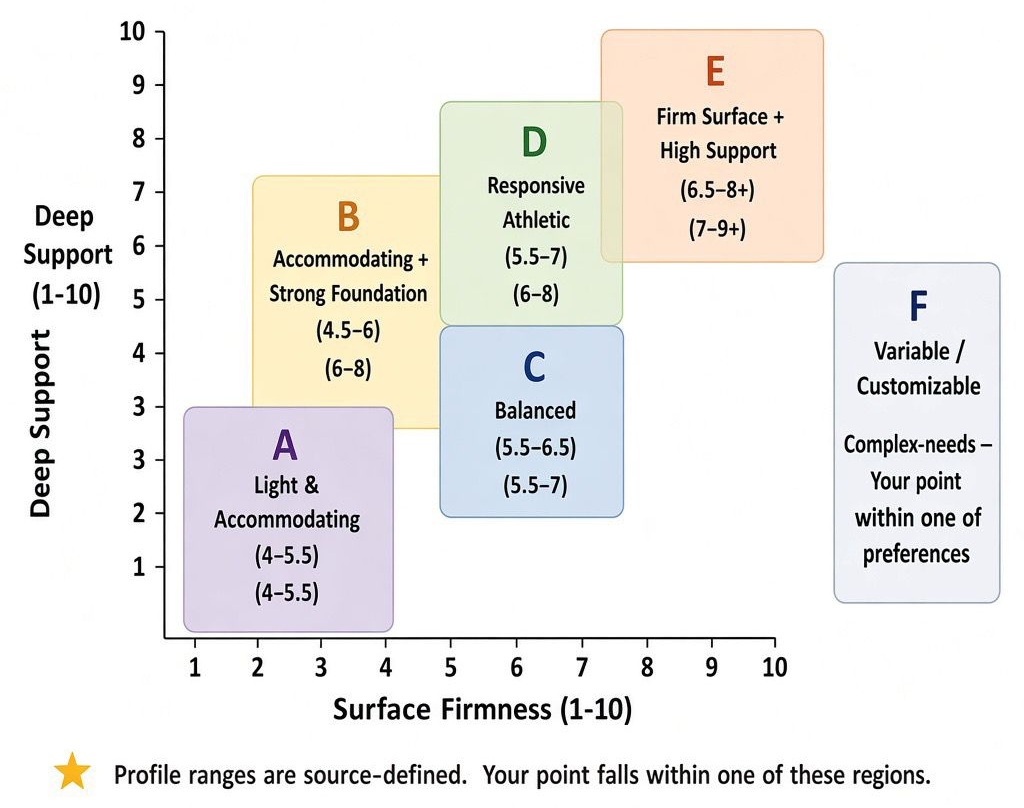
PROFILE A — LIGHT & ACCOMMODATING
Surface: 4–5.5 | Support: 4–5.5
Commonly: Lighter side sleepers.
Look for: 3–4" accommodating comfort system; moderate transition; appropriate foam, latex, or responsive coil support.
Priority: Pressure relief.
PROFILE B — ACCOMMODATING SURFACE / STRONG FOUNDATION
Surface: 4.5–6 | Support: 6–8
Commonly: Heavier, muscular, broad, or curvy side sleepers.
Look for: 2.5–3.5" accommodating comfort system; progressive transition; strong pocketed coils, latex, or robust foam support; zoning when indicated.
Priority: Pressure relief without pelvic collapse.
PROFILE C — BALANCED
Surface: 5.5–6.5 | Support: 5.5–7
Commonly: Moderate-sized back and side/back sleepers.
Look for: 2–3" comfort system; moderate transition; strong foam, latex, or coil core.
Priority: Balance.
PROFILE D — RESPONSIVE ATHLETIC
Surface: 5.5–7 | Support: 6–8
Commonly: Combination sleepers and people who move frequently.
Look for: Latex; responsive foams; pocketed coils; potential microcoils; moderate contouring.
Priority: Support + pressure management + easy repositioning.
PROFILE E — FIRM SURFACE / HIGH SUPPORT
Surface: 6.5–8 | Support: 7–9
Commonly: Larger back/stomach sleepers.
Look for: Shallower/firmer comfort system; strong transition; robust support core; strong central resistance.
Priority: Control pelvic displacement.
PROFILE F — ADJUSTABLE / COMPLEX
Variable
Commonly: Partners with dramatically different requirements; unusual bodies; changing needs.
Look for: Split firmness; modular latex; adjustable air; custom zoning.
Priority: Solve complex or conflicting requirements.
A heavier side sleeper does not necessarily need a hard sleeping surface. They may need a forgiving surface over a powerful foundation.
MATTRESS MATERIALS

MEMORY FOAM
- Contouring
- Pressure redistribution
- Motion isolation
Particularly interesting for side sleepers and pressure-sensitive sleepers. Potential drawbacks include slower response and greater enveloping/sinking sensations.
LATEX
- Faster response
- Progressive resistance
- Easier movement
- Good durability
- Less “stuck” sensation
Particularly interesting for combination sleepers and people wanting responsiveness. Latex is not inherently firm; it can be manufactured across different firmness ranges.
POCKETED COILS
- Strong support
- Responsiveness
- Airflow
- Regional compression
- Zoning potential
- Better motion isolation than interconnected coils
They can pair particularly well with accommodating comfort layers.
ALL-FOAM
- Motion isolation
- Quiet operation
- Contouring
- Wide variety of feels
For people with very high Deep Support scores, examine the underlying construction carefully rather than assuming thickness equals support.
ADJUSTABLE AIR
- Different settings between partners
- Adjustability when needs change
- Variable underlying resistance
An adjustable support core does not eliminate the importance of the comfort layers above it.
DON'T FALL FOR MATTRESS MARKETING
- Thicker ≠ Better
- More Coils ≠ Better
- More Zones ≠ Better
- Higher Foam Density ≠ Automatically Firmer
- Firmer ≠ More Supportive
- Softer ≠ Better Pressure Relief for Everyone
- Expensive ≠ Better Fit
- “Orthopedic” ≠ Automatically Appropriate
|
The only question that ultimately matters is: Does the entire system appropriately accommodate and support your body? |
APPLY YOUR PERSONAL FILTERS
Once several mattresses satisfy your biomechanical profile, then consider preferences. Not before.
DO YOU SLEEP HOT?
- Airflow
- Coil systems
- Latex
- Breathable covers
- Less enveloping constructions
Do not automatically reject foam, but pay greater attention to thermal design.
DO YOU MOVE FREQUENTLY?
- Latex
- Responsive foam
- Pocketed coils
- Microcoils
A mattress should not make normal repositioning unnecessarily difficult.
DO YOU LIKE SLEEPING "IN" OR "ON" A MATTRESS?
Prefer a deep hug? Memory foam may appeal to you. Prefer floating more on top? Latex or responsive hybrids may be more appealing. Somewhere between? Many hybrid constructions can provide that balance. Preference becomes the tiebreaker after mechanical fit.
DO YOU SHARE YOUR BED?
- Motion isolation
- Edge support
- Mattress width
- Different firmness requirements
If partners’ calculated firmness targets are within approximately one point, a shared conventional mattress is reasonable to investigate. A difference of one to two points deserves careful testing. A difference greater than roughly two points should make you seriously investigate split firmness, modular systems, or dual-adjustable systems. These cutoffs are practical Outsiders guidelines rather than clinically validated thresholds.
DON'T FORGET YOUR PILLOW
Your mattress positions the torso and pelvis. Your pillow helps position your head and cervical spine. They are one system.
A new mattress can change the pillow you need.
On a firm mattress, the shoulder may not sink very far, so the distance between the head and mattress remains relatively large. On a more accommodating mattress, the shoulder sinks farther and the head becomes closer to the mattress. The ideal pillow loft may therefore decrease.
Do not evaluate a new mattress while automatically assuming your old pillow remains perfect. Pillow design can influence waking symptoms and cervical outcomes, but the literature does not support one universal pillow for everyone.
TEST & VERIFY
THE OUTSIDERS 15-MINUTE MATTRESS TEST
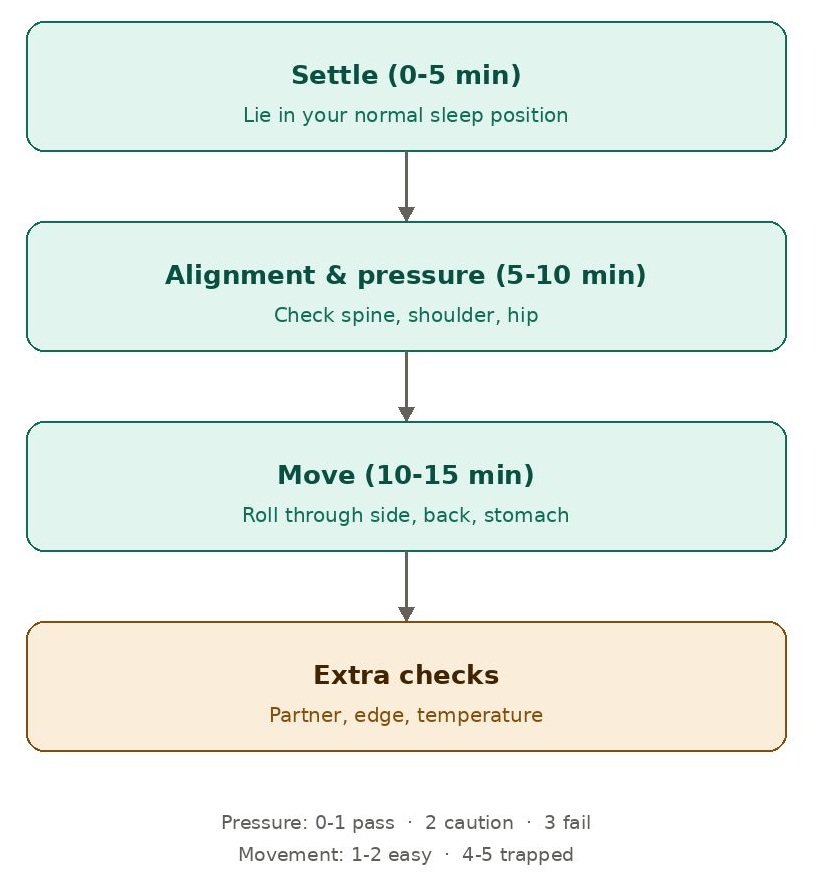
Never buy a mattress because it felt comfortable for thirty seconds. Lie down exactly as you sleep at home. Use your normal type of pillow whenever possible.
Minutes 0–5 — Settle
Get into your primary sleeping position. Do not create artificial “perfect posture.” Sleep normally. Ask: Too hard? Slightly firm? Comfortable? Slightly soft? Too soft? Then wait.
Minutes 5–10 — Alignment and Pressure
SIDE SLEEPERS
Have someone view you directly from behind. Look at the head, neck, thorax, lumbar region, and pelvis. We are not trying to make the anatomical spine literally straight in every plane. We are looking for obvious lateral displacement.
SHOULDER — YIELD
WAIST — SUPPORT
PELVIS — STOP
If the shoulder cannot sink: insufficient accommodation. If the pelvis falls excessively: insufficient deep support. Those are different problems. Do not automatically solve both by changing global firmness.
Pressure Check
|
Score |
Meaning |
|
0 |
Nothing |
|
1 |
Noticeable |
|
2 |
Uncomfortable |
|
3 |
Makes me want to move |
Check shoulder, ribs, hip, and leg/knee. 0–1 = PASS. 2 = CAUTION. 3 = FAIL.
BACK SLEEPERS
- Is my pelvis comfortably accommodated?
- Does it feel like it is sinking dramatically below my torso?
- Does my lumbar region feel comfortably supported?
- Is there concentrated pressure?
- Can I relax without feeling forced into position?
STOMACH SLEEPERS
Ask: Do my hips feel like they are dropping significantly below my rib cage? If yes, deep support may be inadequate. Also examine pillow height carefully.
Minutes 10–15 — Move
Roll naturally: Side → Back; Back → Side; Side → Opposite Side; include stomach if appropriate.
|
Movement Rating |
Meaning |
|
1 |
Effortless |
|
2 |
Easy |
|
3 |
Noticeable resistance |
|
4 |
Difficult |
|
5 |
Trapped |
Frequent combination sleepers should generally prefer the lower end of this scale.
PARTNER TEST
Have your partner roll over, sit down, get up, and return to bed. Ask: Was I significantly disturbed?
EDGE TEST
Move toward the edge. Ask: Do I remain supported? Then sit on the edge. This matters especially if you share a smaller bed, sleep near the edge, frequently sit on the edge, or need assistance getting up.
TEMPERATURE CHECK
Fifteen minutes cannot predict an entire night, but if you are already becoming noticeably hot, pay attention. The home trial will provide the real answer.
YOUR MATTRESS SCORECARD
|
Test |
Pass |
Caution |
Fail |
|
Alignment |
□ |
□ |
□ |
|
Shoulder Pressure |
□ |
□ |
□ |
|
Hip Pressure |
□ |
□ |
□ |
|
Pelvic Support |
□ |
□ |
□ |
|
Pillow Alignment |
□ |
□ |
□ |
|
Repositioning |
□ |
□ |
□ |
|
Temperature |
□ |
□ |
□ |
|
Motion Isolation |
□ |
□ |
□ |
|
Edge Support |
□ |
□ |
□ |
|
Overall Comfort |
□ |
□ |
□ |
|
An Alignment or Support Failure Is Not Overridden by a High Total Score. |
If the mattress fails the fundamental job, do not buy it simply because everything else feels luxurious.
Click here to DOWNLOAD YOUR WORKSHEET
THE OUTSIDERS MATTRESS DECISION HIERARCHY
1. ALIGNMENT
Does your body remain appropriately positioned?
2. PRESSURE
Can you remain there comfortably?
3. SUPPORT
Does the mattress prevent excessive sinking?
4. MOVEMENT
Can you reposition naturally?
5. TEMPERATURE
Can you remain thermally comfortable?
6. PARTNER COMPATIBILITY
Does it work for both sleepers?
7. PREFERENCE
Do you like how it feels?
Preference matters. But it comes after function.
USE THE HOME TRIAL
The showroom test screens candidates. The home trial determines whether the mattress actually works.
MORNING 1
- Any new pressure?
- Any unusual stiffness?
- Too hot?
- Comfortable?
Do not panic over one night’s experience.
END OF WEEK 1
- Am I becoming more comfortable?
- Is shoulder pressure developing?
- Hip pressure?
- Morning stiffness?
- Am I constantly repositioning?
- Am I sleeping hot?
WEEK 2–4
- Overall sleep comfort
- Morning comfort
- Pressure
- Positioning
- Temperature
- Repositioning
- Partner disturbance
- Any noticeable impressions
Research in people changing sleep surfaces suggests changes in comfort and symptoms can evolve over several weeks rather than being fully apparent on the first night. That is why a meaningful home trial matters.
FINALIZE YOUR PROFILE
THE COMPLETE FIVE-MINUTE WORKSHEET
If you do not want to remember anything else in this article, save this section.
MEASURE
- Weight: ______ lb
- Height: ______ in
- Shoulders: ______ in
- Waist: ______ in
- Hips: ______ in
HOW DO YOU SLEEP?
Side: ______% Back: ______% Stomach: ______% Total = 100%
SURFACE
- Start: 6.0
- Weight adjustment: (Weight − 175) ÷ 100 = ______
- Position adjustment: Side × −.50 + Back × 0 + Stomach × .50 = ______
- Shoulder contour: (Shoulders − Waist) ÷ Waist × 100 = ______%
- Hip contour: (Hips − Waist) ÷ Waist × 100 = ______%
- Contour adjustment: 0 to −.50 × side-sleep percentage = ______
- Pressure adjustment: 0 / −.25 / −.50 = ______
|
MY SURFACE TARGET = ______ |
Begin testing approximately ±0.5, while allowing a somewhat broader range because manufacturers’ firmness scales are not standardized.
SUPPORT
- Start: 5
- Weight load: (Weight − 175) ÷ 50 = ______
- Central load: Waist ÷ Hips = ______
- Apply: 0 / +.25 / +.50 / +.75
- Position support: Side × .25 + Back × .50 + Stomach × 1.0 = ______
|
MY DEEP SUPPORT SCORE = ______ / 10 |
ZONING
- Shoulder contour × Side %: ______
- Hip contour × Side %: ______
Use the larger number: Under 5 — Minimal | 5–10 — Low | 11–20 — Moderate | 21–30 — High | 30+ — Very High
|
MY ZONING NEED = ______ |
Click here to DOWNLOAD YOUR WORKSHEET
YOUR FINAL PROFILE
|
MY OUTSIDERS MATTRESS PROFILE |
Click here to DOWNLOAD YOUR WORKSHEET
WHAT WE'RE REALLY TRYING TO ACCOMPLISH
There is no mattress that can guarantee perfect sleep.
There is no firmness number that works for every body.
And a mattress is not a treatment for every ache or pain.
Persistent or worsening pain, weakness, numbness, tingling, unexplained nighttime symptoms, or other concerning symptoms deserve appropriate medical evaluation.
But mattress selection does not need to be random either. The available research gives us several useful principles: medium-firm surfaces perform well as a general population starting point; firmest is not automatically best; sleeping position matters; anthropometrics and regional mattress properties matter; and the literature does not justify one universal mathematical target for perfect spinal alignment or pressure distribution.
So we use the research to establish the principles. We use your measurements to narrow the range. And then we use your body to verify the result.
THE OUTSIDERS APPROACH
We talk constantly about training. But training is only one side of adaptation. Training creates a stimulus. Recovery allows adaptation. And sleep represents hours of recovery opportunity every single day.
The mattress underneath you is not going to make you fitter. It is not going to replace good programming. It is not going to fix poor nutrition. It is not going to cure an injury. But if you are going to spend roughly one-third of your life sleeping and recovering, it makes sense to create the best environment you reasonably can for those hours.
Do not start by asking: What’s the best mattress?
Ask: What does my body require from a mattress?
Measure. Calculate. Match. Test. Then listen to what your body tells you. Because the best mattress is not necessarily the softest, firmest, or most expensive. It is the one that allows your body to remain comfortably supported and appropriately positioned while you recover.
CHOOSE THE ACTUAL MATTRESS
FROM YOUR SCORE TO AN ACTUAL MATTRESS
You’ve done the measurements. You’ve calculated your Surface Firmness. You’ve determined your Deep Support Requirement. You’ve evaluated your need for zoning. Now comes the question that matters: What do I actually buy?
The answer is not necessarily one particular mattress. Your Outsiders Mattress Profile identifies a type of mechanical environment your body is likely to need. Our job now is to find mattresses capable of creating it. Start with your three primary results: Surface Firmness, Deep Support, and Zoning Need.
PROFILE A — LIGHT & ACCOMMODATING
Typical Results: Surface: 4–5.5 | Support: 4–5.5
Often Appropriate For: Lighter side sleepers.
Look For: 3–4" accommodating comfort system; moderate transition; appropriate foam, latex, or responsive coil support.
Primary Goal: Pressure relief.
PROFILE B — ACCOMMODATING SURFACE / STRONG FOUNDATION
Typical Results: Surface: 4.5–6 | Support: 6–8
Often Appropriate For: Heavier, muscular, broad, or curvy side sleepers.
Look For: 2.5–3.5" accommodating comfort system; progressive transition; strong pocketed coils, latex, or robust foam support; zoning when indicated.
Primary Goal: Pressure relief without pelvic collapse.
PROFILE C — BALANCED
Typical Results: Surface: 5.5–6.5 | Support: 5.5–7
Often Appropriate For: Moderate-sized back and side/back sleepers.
Look For: 2–3" comfort system; moderate transition; strong foam, latex, or coil core.
Primary Goal: Balance.
PROFILE D — RESPONSIVE ATHLETIC
Typical Results: Surface: 5.5–7 | Support: 6–8
Often Appropriate For: Combination sleepers and people who move frequently.
Look For: Latex; responsive foams; pocketed coils; potential microcoils; moderate contouring.
Primary Goal: Support + pressure management + easy repositioning.
PROFILE E — FIRM SURFACE / HIGH SUPPORT
Typical Results: Surface: 6.5–8 | Support: 7–9
Often Appropriate For: Larger back/stomach sleepers.
Look For: Shallower/firmer comfort system; strong transition; robust support core; strong central resistance.
Primary Goal: Control pelvic displacement.
PROFILE F — ADJUSTABLE / COMPLEX
Typical Results: Variable
Often Appropriate For: Partners with dramatically different requirements; unusual bodies; changing needs.
Look For: Split firmness; modular latex; adjustable air; custom zoning.
Primary Goal: Solve complex or conflicting requirements.
CUSTOMIZABLE MATTRESSES
A customizable mattress allows one or more components to be changed rather than forcing the sleeper to accept a single factory configuration. Customization can occur through:
- Split firmness
- Replaceable comfort layers
- Rearrangeable latex layers
- Different firmness on each side
- Adjustable air chambers
- Adjustable zones
- Modular support components
This can solve problems conventional mattresses cannot.
TYPE 1 — SPLIT FIRMNESS
Imagine Sleeper A has a Surface target of 4.5 and Sleeper B has a Surface target of 7. A conventional mattress averaging the two at approximately 5.75 may leave both people unhappy. Split firmness allows each side to provide a different sleeping environment and deserves strong consideration when partners’ calculated requirements differ substantially.
TYPE 2 — MODULAR LATEX
A modular latex mattress may contain several separate latex layers. One sleeper might use Soft / Medium / Firm, while another uses Medium / Firm / Extra Firm. The layers can sometimes be rearranged or replaced. If the surface is too firm, change the upper layer. If deep support is insufficient, change the lower configuration.
Manufacturers worth investigating include Sleep EZ, FloBeds, Naturepedic, and other modular latex manufacturers. Individual models and current configurations should always be verified before purchase.
TYPE 3 — ADJUSTABLE AIR
Adjustable-air mattresses alter support using internal air chambers. Resistance can be changed after purchase, and some systems allow different settings on each side. This can be valuable for couples, changing body weight, changing preferences, pregnancy, recovery periods, and people uncertain about firmness.
Adjustable firmness does not eliminate mattress construction. The materials above the air chambers still determine pressure relief, surface accommodation, responsiveness, temperature, and feel. Evaluate the entire system.
TYPE 4 — CUSTOMIZABLE ZONING
This may be the most biomechanically interesting category. Imagine being able to create more shoulder accommodation, more waist support, and controlled pelvic accommodation. Instead of selecting one firmness across the entire body, the mattress can be tuned regionally.
For sleepers with High or Very High Zoning Need scores, this deserves serious consideration. The important question is not how many zones a mattress advertises. It is whether those zones can be configured in locations that correspond reasonably well to your anatomy.
WHEN CUSTOMIZATION MAKES SENSE
- Partner requirements differ substantially.
- Your Zoning Need is High or Very High.
- You have unusual body proportions.
- You are not sure which firmness will work.
- You want the ability to modify rather than replace the mattress.
- Your body weight or sleeping needs are likely to change.
- You have repeatedly failed to find an appropriate conventional mattress.
Customization is not automatically better. It is simply another tool. If a conventional mattress fits your body beautifully, there is no need to complicate things.
THE MATTRESS MATCH CARD
Every mattress we recommend should eventually be evaluated using the same card.
|
OUTSIDERS MATTRESS MATCH |
|
|
Mattress |
________________ |
|
Best Outsiders Profile |
________________ |
|
Estimated Surface Range |
________________ |
|
Deep Support |
________________ |
|
Zoning |
________________ |
|
Comfort System |
________________ |
|
Transition |
________________ |
|
Support Core |
________________ |
|
Responsiveness |
________________ |
|
Pressure Relief |
________________ |
|
Cooling |
________________ |
|
Motion Isolation |
________________ |
|
Edge Support |
________________ |
|
Customization |
________________ |
|
Best Sleeping Positions |
________________ |
|
Body Sizes Most Likely to Match |
________________ |
|
Trial Period |
________________ |
|
Warranty |
________________ |
|
Price Category |
________________ |
Why We Included It: ________________________________________________
Potential Reasons It May Not Fit: ____________________________________
This keeps every recommendation accountable to the same standard.
Click here to DOWNLOAD YOUR WORKSHEET
WHY WE RECOMMENDED IT
We will not recommend mattresses because they are popular, promoted by celebrities, expensive, labeled orthopedic, marketed with “recovery technology,” or present on someone else’s Best Mattress list.
- What Outsiders profile does it serve?
- What does the comfort system accomplish?
- What provides deep support?
- Is it zoned?
- Who is likely to benefit from that zoning?
- How responsive is it?
- How well does it manage pressure?
- What are its limitations?
That final question matters. Every mattress has limitations.
WHY WE MIGHT NOT RECOMMEND A POPULAR MATTRESS
Insufficient construction transparency
If we cannot determine how the mattress works, we are reluctant to tell you it matches a particular profile.
Excessive marketing claims
Terms such as Orthopedic, Therapeutic, Recovery, Luxury, and Doctor-designed do not automatically tell us anything meaningful about mechanical fit.
Poor customization for its intended sleeper
A side-sleeper mattress that does not provide adequate shoulder accommodation does not earn a recommendation merely because it is marketed toward side sleepers.
Inadequate trial policy
Fit ultimately needs to be verified at home.
Poor value
A $5,000 mattress is not automatically better than a $1,500 mattress.
Wrong construction for the profile
A mattress can be extremely well built and simply be inappropriate for a particular person. That is not a bad mattress. It is a bad match.
SUPPORTING SYSTEMS & LONGEVITY
MATTRESS + FOUNDATION + PILLOW
PILLOW + MATTRESS + FOUNDATION
All three affect positioning.
THE FOUNDATION
A mattress designed for a rigid platform can behave differently on an inappropriate or deteriorating foundation. Before replacing a mattress, inspect the bed frame, slats, center support, foundation, and box spring if applicable. Follow the mattress manufacturer’s foundation requirements.
THE PILLOW
The pillow completes the positioning system. Especially for side sleepers: mattress determines shoulder penetration → that determines head-to-mattress distance → that influences required pillow loft. Whenever you substantially change mattress construction, reassess your pillow.
WHEN SHOULD YOU REPLACE YOUR MATTRESS?
Do not replace a mattress simply because someone says mattresses must be replaced after an arbitrary number of years. Ask a better question: Does my mattress still perform the way I need it to?
- Permanent impressions
- Sagging
- Changed surface feel
- Loss of support
- Edge deterioration
- Increased pressure
- Increasing difficulty repositioning
- New partner requirements
- Significant body-weight changes
- Major changes in sleeping position
RECALCULATE WHEN YOUR BODY CHANGES
- Body weight
- Body composition
- Sleeping position
- Partner
- Pregnancy
- Mobility
- Physical needs
- Mattress construction
The mattress does not exist independently of the sleeper. Fit is a relationship.
WORKED EXAMPLE 1
120-Pound Predominant Side Sleeper
- Weight: 120 lb
- Sleep: 90% side / 10% back
- Pronounced hips and shoulders.
Surface: approximately 4–5
Deep Support: Moderate
Zoning: High
Likely Profile: A
Look for an accommodating surface with sufficient shoulder and hip penetration without unnecessary firmness. Potential candidates: softer hybrid configurations, appropriately soft latex configurations, pressure-relieving foam systems, customizable latex if zoning requirements are substantial.
WORKED EXAMPLE 2
180-Pound Broad-Shouldered Side/Back Sleeper
- Weight: 180 lb
- Sleep: 70% side / 30% back
- Broad shoulders; moderate waist; moderate hips.
Surface: approximately 5–6
Deep Support: Moderate-High
Zoning: Moderate-High
Likely Profile: B/C
This person may benefit considerably from shoulder accommodation plus strong underlying support. Potential candidates include medium hybrids with zoning, latex hybrids, or customizable systems.
WORKED EXAMPLE 3
225-Pound Athletic Side Sleeper
- Weight: 225 lb
- Sleep: 90–100% side
- Broad shoulders; relatively narrow waist.
Surface: approximately 5–6
Deep Support: High
Zoning: High/Very High
Likely Profile: B
Heavy does not automatically mean firm. This person may require a medium/accommodating surface over a highly supportive transition and core with meaningful shoulder accommodation.
WORKED EXAMPLE 4
275-Pound Back/Stomach Sleeper
- Weight: 275 lb
- Sleep: 60% back / 40% stomach
- Greater central load.
Surface: approximately 7
Deep Support: Very High
Central Support: High Priority
Likely Profile: E
Look for strong progressive resistance, a robust support core, controlled pelvic displacement, and appropriate but not excessive comfort depth.
WORKED EXAMPLE 5
Two Very Different Sleepers
- Partner A: 125 lb side sleeper; calculated surface ~4.5
- Partner B: 250 lb back/stomach sleeper; calculated surface ~7
A compromise around 5.5–6 may be wrong for both.
Likely Profile: F — Customizable
Consider split firmness, modular latex, dual-adjustable air, separate internal constructions, or split mattresses when appropriate. Sometimes customization is the better compromise.
THE OUTSIDERS MATTRESS SHORTLIST
When we create our final recommendation catalog, mattresses are grouped by Profile A through F. Within each category we aim to provide Value, Mid-Range, Premium, and Customizable options when appropriate.
|
No single mattress is labeled THE BEST MATTRESS. |
THE FINAL RULE
After all of the measurements, calculations, construction study, specifications, and narrowing of choices, your body still gets the final vote.
|
The formula identifies the neighborhood. |
TOO MUCH SHOULDER PRESSURE?
Investigate greater surface accommodation.
PELVIS SINKING?
Investigate greater transition/deep support.
HEAD POORLY POSITIONED?
Reassess the pillow.
TOO DIFFICULT TO MOVE?
Increase responsiveness.
TOO HOT?
Change thermal characteristics.
PARTNER WAKES YOU?
Increase motion isolation.
The purpose of the system is not to give you a number and tell you what to buy. It is to teach you how to think. The ultimate goal is confidence: not confidence because someone told you which mattress was “best,” but confidence because you understand how to determine which mattress is best for you.
MANUFACTURER FIRMNESS IS NOT OUR FIRMNESS
Before using the Mattress Match Catalog, there is one important distinction to understand.
Surface Firmness Target: 5.5–6.5
That does not mean every mattress advertised by a manufacturer as a “6 out of 10” will feel or perform the same. There is no universal consumer mattress-firmness scale.
One company’s 6/10 may feel noticeably different from another company’s 6/10 because of:
- Comfort-layer material
- Comfort-layer thickness
- Foam compression characteristics
- Latex firmness
- Transition-layer design
- Coil construction
- Zoning
- Support-core design
- Overall mattress thickness
- Your body weight
- Your body shape
- Your sleeping position
This is why our calculator should be viewed as a target range, not as a product label. Your calculated number tells us what kind of surface response your body is likely to need. The manufacturer’s firmness rating helps us identify mattresses that may fall into that neighborhood. But the manufacturer’s number is only a starting point.
|
Outsiders Calculated Surface Target |
For example, two mattresses may both be marketed as 6/10. One may use several inches of slow-response memory foam over a foam support core. The other may use responsive latex over pocketed coils. Both may technically fall near your target, but they may feel completely different.
|
Your calculated firmness is the neighborhood. |
RECOMMENDATIONS & CLOSING
MATTRESS RECOMMENDATIONS BY OUTSIDERS PROFILE
Once you calculate your Outsiders Mattress Profile, the next step is not to search for the “best mattress.” The better question is: Which mattresses are most likely to match my calculated Surface Firmness, Deep Support Requirement, and Zoning Need? Do not start with the mattress list. Start with your profile. Then narrow the choices.
Mattress Match Catalog — Last Reviewed August 2026
Mattress models, constructions, firmness options, prices, trials, and warranties change. Always verify current manufacturer specifications before purchasing.
PROFILE A — LIGHT & ACCOMMODATING
Typical Results: Surface 4–5.5 | Deep Support 4–5.5
Nolah Evolution — Plush
A strong candidate for lighter side sleepers who want greater contouring and pressure relief. The Plush version provides a softer upper feel while retaining an individually wrapped coil support system underneath. Best for lighter side sleepers, higher pressure sensitivity, and people who prefer more contouring. Use caution if you strongly prefer sleeping “on” rather than “in” the mattress or if your Deep Support score is unusually high.
Brooklyn Bedding Signature Hybrid — Soft
A useful option for sleepers who want a softer hybrid without moving into an especially complicated or expensive design. Best for lighter side sleepers, moderate pressure-relief needs, conventional hybrid feel, and value-conscious shoppers. Use caution with High or Very High Zoning Need.
Naturepedic EOS Classic — Plush
A customizable latex-and-coil option with split firmness and replaceable internal components. Best for lighter side sleepers, couples with different needs, people uncertain about long-term firmness, and people who value modular construction.
PROFILE B — ACCOMMODATING SURFACE + STRONG FOUNDATION
Typical Results: Surface 4.5–6 | Deep Support 6–8
Helix Midnight Luxe
A clear Profile B construction combining pressure-relieving upper layers with zoned pocketed coils. Best for side sleepers, broad shoulders, moderate-to-high Deep Support, higher Zoning Needs, and people who like a contouring hybrid feel.
Nolah Evolution — Luxury Firm
A useful middle ground for medium-to-heavier side sleepers who need meaningful cushioning over stronger support.
Bear Elite Hybrid — Medium
Another hybrid candidate for side/back combination sleepers, moderate pressure-relief needs, and medium-to-high support requirements. It belongs on the list for construction fit—not athletic marketing.
PROFILE C — BALANCED
Typical Results: Surface 5.5–6.5 | Deep Support 5.5–7
Saatva Classic — Luxury Firm
A responsive, more traditional mattress feel rather than a deep foam cradle. Best for back sleepers, side/back combination sleepers, people who like sleeping more “on” the mattress, and moderate Deep Support requirements.
Brooklyn Bedding Signature Hybrid — Medium
A straightforward medium hybrid for sleepers who do not require extreme zoning or unusually high support.
Naturepedic EOS Classic — Medium
A balanced latex-and-coil option with the ability to change internal components later.
PROFILE D — RESPONSIVE ATHLETIC
Typical Results: Surface 5.5–7 | Deep Support 6–8
Avocado Green — Medium
Latex-and-coil construction with a more buoyant feel than deep memory-foam systems. Best for combination sleepers, people who move frequently, hot sleepers, and those who prefer sleeping more “on” than deeply “in” the mattress.
Engineered Sleep Duo Latex Plus
A system that separates comfort from underlying support more clearly than many conventional mattresses. Best for combination sleepers, people who want latex responsiveness, medium surface targets, and moderate-to-high deep support.
Sleep EZ Organic Latex
A modular latex system whose layers can be selected, rearranged, and replaced. Best for combination sleepers, people who dislike memory-foam sink, couples with different needs, and people who want modular construction.
PROFILE E — FIRM SURFACE + HIGH SUPPORT
Typical Results: Surface 6.5–8+ | Deep Support 7–9+
Helix Dawn Luxe
Designed toward a firmer feel and stronger central support. Best for back/stomach sleepers and higher Deep Support requirements.
Brooklyn Bedding Plank Firm Luxe
A flippable hybrid for sleepers whose calculated Surface target is genuinely high. Use caution if you are primarily a side sleeper, have pronounced shoulders or hips, or have high pressure sensitivity.
Engineered Sleep Duo Essential
Another firmer option for people whose calculations show both elevated Surface Firmness and Deep Support requirements.
PROFILE F — CUSTOMIZABLE AND COMPLEX NEEDS
Typical Results: Variable
Naturepedic EOS Classic
Excellent for couples with different Surface Firmness needs, people uncertain about firmness, and people wanting replaceable components.
Sleep EZ Organic Latex
Multiple latex firmnesses and split-layer options allow surface feel and deep support to be tuned separately.
FloBeds vZone
Regional adjustment can provide more shoulder accommodation, more waist/lumbar support, and controlled pelvic accommodation. Particularly interesting for High or Very High Zoning Need.
Saatva Solaire
Adjustable air chambers allow substantial support adjustment and different partner settings in larger sizes.
Engineered Sleep Duo
A middle ground between a conventional fixed mattress and a fully modular system.
WHICH CUSTOMIZABLE MATTRESS SHOULD YOU INVESTIGATE?
|
Primary Problem |
First Construction to Investigate |
|
Partners need different firmness |
Naturepedic EOS / Sleep EZ / Saatva Solaire |
|
Shoulder needs much more accommodation than waist |
FloBeds vZone / carefully designed zoned system |
|
Unsure about firmness |
Naturepedic EOS / Sleep EZ / Saatva Solaire |
|
Want replaceable components |
Naturepedic EOS / Sleep EZ |
|
Want a highly responsive feel |
Modular latex systems |
|
Needs change frequently |
Saatva Solaire |
|
Very High Zoning Need |
FloBeds vZone / adjustable regional system |
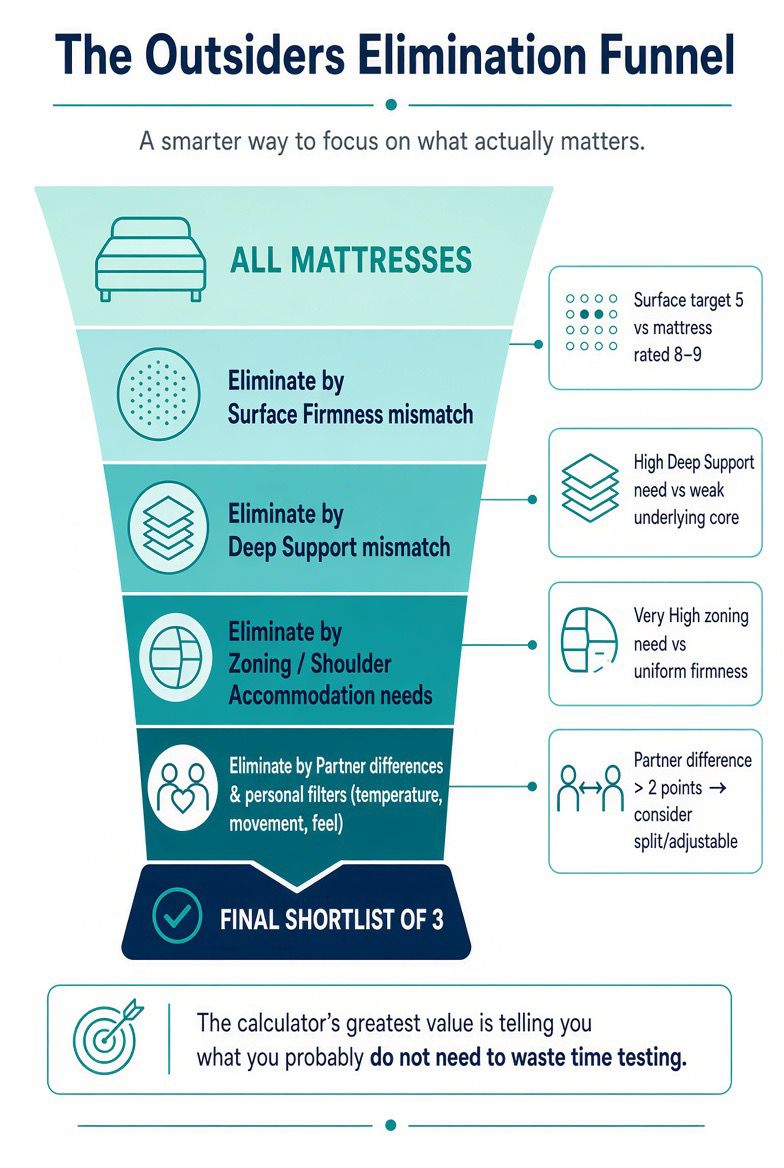
HOW TO BUILD YOUR FINAL THREE-MATTRESS SHORTLIST
Mattress 1 — Conventional Match
Choose one mattress that closely matches your Surface, Support, and Zoning profile.
Mattress 2 — Different Material Architecture
Choose a mattress with similar mechanical characteristics but different materials, such as foam hybrid versus latex hybrid.
Mattress 3 — Customizable Option, when appropriate
Especially valuable for high zoning requirements, a partner with very different needs, previous mattress-selection failures, or significant uncertainty.
THE OUTSIDERS ELIMINATION RULE
The easiest way to shop for a mattress may not be to ask: Why should I buy this? Instead ask: Why should I eliminate it?
- If your Surface target is around 5 and a mattress is clearly designed as an 8–9: eliminate it.
- If your Deep Support Requirement is 8 and the mattress has a deep soft comfort system over questionable underlying resistance: eliminate it or test very carefully.
- If you have Very High Shoulder Accommodation and the mattress provides little opportunity for the shoulder to sink: eliminate it or test very carefully.
- If you and your partner differ by more than approximately two Surface Firmness points: investigate split or adjustable systems first.
- If you sleep hot and dislike deep contouring: do not choose a deeply enveloping foam mattress simply because its firmness number looks correct.
|
The calculator’s greatest value may not be telling you what to buy. It tells you what you probably do not need to waste time testing. |
ONE FINAL REMINDER
Manufacturer firmness numbers are not standardized. Use manufacturer firmness ratings to identify candidates, then use your calculations, the 15-Minute Mattress Test, and the home trial to determine whether the mattress actually works for you.
The purpose of this list is not to tell you which mattress is best. It is to help you create a much smaller, much more intelligent shortlist. The best mattress is not the mattress with the best reviews, the highest price, or the one another person loves. It is the mattress whose construction most closely matches what your body actually requires.
SOURCES & METHODOLOGY — WHAT THE SCIENCE TELLS US AND WHAT IT DOES NOT
The Outsiders Mattress Selection System was created to make mattress selection more systematic. But there is an important distinction we want to make very clear.
|
The scientific research provides principles. |
Research examining mattresses, sleep quality, spinal alignment, and low-back symptoms provides useful guidance. However, the research does not currently give us a clinically validated equation capable of taking someone’s weight, measurements, and sleeping position and declaring: “Your perfect mattress firmness is exactly 5.73.” That level of precision does not exist, and we do not want to pretend that it does.
Systematic reviews of mattress research have generally found medium-firm mattresses to be a reasonable population-level starting point for sleep comfort, spinal alignment, and nonspecific low-back symptoms. A randomized controlled trial involving adults with chronic nonspecific low-back pain also found better outcomes with a medium-firm mattress than a firm mattress, challenging the common assumption that harder automatically means better for the back.
This gives us several useful principles:
- Firmer is not automatically better.
- Softer is not automatically better.
- Body characteristics matter.
- Sleeping position matters.
- Pressure distribution matters.
- Spinal positioning matters.
- Customization may be valuable.
- The same mattress will not behave identically for every person.
The research also has limitations. Studies use different mattress constructions. Firmness measurements are not always standardized. People differ substantially in body size and shape. Sleeping positions change throughout the night. Comfort is partly subjective. And there is no universally accepted numerical threshold defining perfect mattress-induced spinal alignment for every human body.
|
The Outsiders formulas are SCREENING TOOLS, not MEDICAL PRESCRIPTIONS. |
HOW WE BUILT THE OUTSIDERS MODEL
BODY WEIGHT
Greater load generally creates greater mattress compression.
SLEEPING POSITION
Side sleeping requires greater accommodation for the shoulder and hip. Back sleeping creates different pelvic and lumbar requirements. Stomach sleeping increases the importance of controlling pelvic displacement.
BODY CONTOUR
Greater shoulder-to-waist or hip-to-waist differences increase the amount of regional accommodation a side sleeper may require.
PRESSURE SENSITIVITY
Someone experiencing concentrated pressure may require additional surface accommodation.
CENTRAL LOAD
Greater central loading can increase underlying support requirements.
ZONING
Large regional differences in body shape may make uniform mattress resistance less desirable.
These relationships form the logic of the model. The specific coefficients, scoring ranges, profile boundaries, and thresholds used in the Outsiders calculator are our practical consumer framework. They have not been clinically validated. That is precisely why the system produces ranges and requires physical verification.
WHY WE USE A RANGE
If your calculation produces 5.8, we do not tell you to buy a 5.8 mattress. Instead, we establish a target range and begin testing within that neighborhood because mattress manufacturers do not share one standardized consumer firmness scale. Your calculated score is best understood as a selection coordinate rather than a laboratory measurement.
WHY YOUR BODY GETS THE FINAL VOTE
- Alignment
- Pressure
- Pelvic support
- Movement
- Temperature
- Pillow position
- Morning comfort
- Actual sleep over time
CALCULATE → TEST → VERIFY
If the mathematics predicts that a mattress should work but your body consistently tells you otherwise, believe your body and reassess the variables.
A NOTE ABOUT SLEEP AND RECOVERY
Sleep itself matters far beyond mattress selection. Adults generally need at least seven hours of sleep regularly for optimal health, with individual sleep needs varying. A mattress cannot compensate for chronically insufficient sleep. It cannot replace appropriate training or nutrition, and it cannot diagnose or treat an injury.
The purpose of mattress selection is narrower: create a sleeping surface that gives your body a reasonable opportunity to remain comfortable and appropriately supported while you sleep and recover. Persistent or worsening pain, numbness, weakness, tingling, unexplained nighttime symptoms, or other concerning symptoms deserve appropriate medical evaluation rather than simply purchasing another mattress.
SELECTED RESEARCH & REFERENCE SOURCES
- American Academy of Sleep Medicine — Adult Sleep Duration Consensus
- Systematic review: mattresses, sleep quality, spinal alignment, and back pain
- Randomized trial: medium-firm vs. firm mattresses for chronic nonspecific low-back pain
- Biomechanical review: mattress support, spinal alignment, and pressure distribution
- Systematic review: sleeping posture and low-back pain
- Pillow research review
- Sleep-surface adaptation study
CONCLUSION — YOUR MATTRESS IS PART OF YOUR RECOVERY ENVIRONMENT
We spend roughly one-third of our lives sleeping.
For someone who trains, hikes, runs, lifts, works hard, or simply wants their body to continue functioning well for decades, those hours matter.
They are not empty hours. They are recovery hours.
Yet most people put considerably more thought into choosing a pair of shoes than choosing the surface they may spend seven or eight hours lying on every night. That does not mean you need the world’s most expensive mattress, the newest technology, or one mattress that everyone should buy.
Stop asking: What is the best mattress?
Start asking: What does my body require from a mattress?
REMEMBER THE THREE JOBS
YIELD
SUPPORT
STOP
Side sleeper:
Shoulder → Yield
Waist → Support
Pelvis → Yield, then Stop
For back and stomach sleepers, the exact relationship changes. But the principle remains.
FIRMNESS IS ONLY ONE VARIABLE
A soft surface and strong support can coexist.
A firm surface and inadequate support can coexist.
A mattress can provide excellent pressure relief but poor responsiveness.
A mattress can provide excellent support but inadequate shoulder accommodation.
That is why mattress selection cannot be reduced to Soft / Medium / Firm. Instead, think: Surface Firmness + Deep Support + Zoning + Construction + Sleeping Position + Your Body.
THEN ELIMINATE
Once you understand your requirements, mattress shopping becomes much easier. You are no longer walking into a store asking “Which one should I buy?” You are walking in knowing approximately what surface you need, how much underlying support you need, whether you need zoning, whether you prefer contouring or responsiveness, whether your partner requires something different, and which mattresses you probably do not need to waste time testing.
THEN TEST
The calculator is not the finish line. It is the filter. Use your calculated profile to create a shortlist. Then perform the Outsiders 15-Minute Mattress Test and use the home trial. Sleep on the mattress. Wake up on it. Move on it. Recover on it. Pay attention to what happens over time.
AND ADJUST WHEN NECESSARY
SHOULDER PRESSURE
Look for greater accommodation.
PELVIS SINKING
Look for stronger transition or deep support.
FEELING TRAPPED
Look for greater responsiveness.
HEAD POORLY POSITIONED
Reassess your pillow.
SLEEPING TOO HOT
Reconsider the thermal characteristics of the construction.
VERY DIFFERENT PARTNER NEEDS
Stop forcing one uniform mattress to solve two different problems. Consider customization.
THE OUTSIDERS APPROACH
Our approach to training has always been based on understanding the individual before applying the solution. Mattress selection should not be any different. Do not choose based solely on marketing, reviews, price, or what worked for someone else.
MEASURE
↓
CALCULATE
↓
MATCH
↓
TEST
↓
VERIFY
Because the goal is not to find the softest mattress, the firmest mattress, or the mattress with the highest rating. The goal is much simpler: find the mattress that allows your body to remain comfortably supported and appropriately positioned while you sleep and recover.
If we can accomplish that, then the mattress is doing its job.
Stay connected with news and updates!
Join our mailing list to receive the latest news and updates from our team. Don't worry, your information will not be shared.
We hate SPAM. We will never sell your information, for any reason.
