
Heat Training Benefits: Why We Train at 80°F | Outsiders
Sep 22, 2026WHY WE TRAIN WARM
The Science Behind Outsiders Kettlebell & Sledgehammer Work Capacity Training
Walk into an Outsiders Work Capacity session and you may notice something almost immediately:
It’s warm.
Our 50-minute kettlebell and sledgehammer Work Capacity workouts are performed in an environment maintained at approximately 80°F.
That is intentional.
We aren’t trying to make exercise miserable.
We aren’t trying to see who can sweat the most.
And we don’t believe that making a workout feel harder automatically makes it better.
Instead, the moderately warm environment adds another controlled physiological demand to an already challenging form of training.
For approximately 50 minutes, we’re combining resistance exercise, cardiovascular conditioning, muscular endurance, coordination, multiplanar movement and sustained work capacity with an additional thermoregulatory challenge.
The objective isn’t simply to become better at exercising in a warm room.
The objective is to build a body that becomes better at managing heat while continuing to perform.
WHAT HAPPENS WHEN YOU EXERCISE IN A WARM ENVIRONMENT?
Exercise produces heat.
Lots of it.
Only a portion of the energy your body produces during exercise becomes mechanical work. Much of the rest ultimately appears as heat that must be dissipated.
As exercise intensity and duration increase, the body has to prevent excessive heat accumulation.
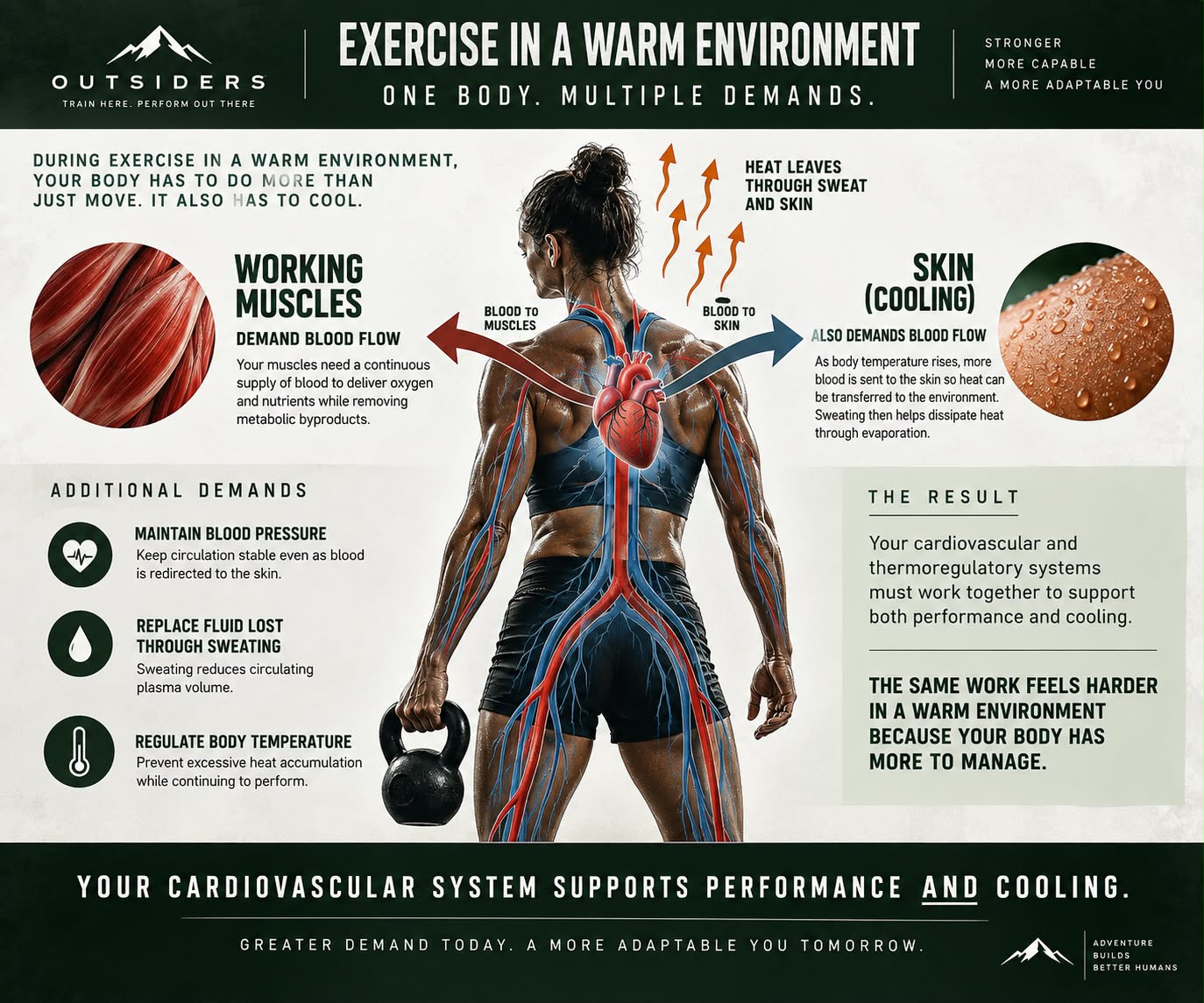
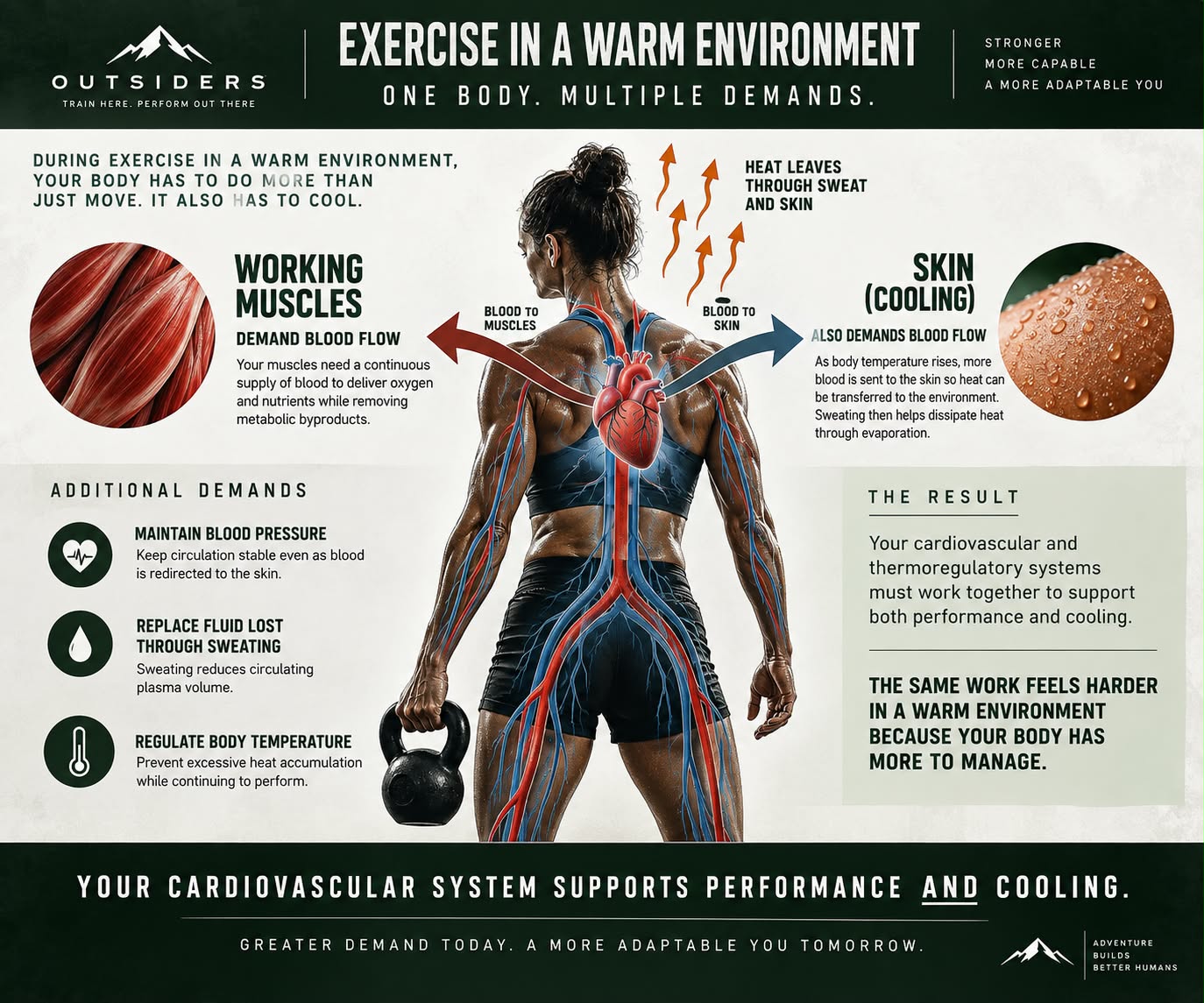
One of its primary solutions is increasing blood flow to the skin.
Warm blood travels from deeper tissues toward the body’s surface, where heat can be transferred to the environment.
Sweating provides another powerful cooling mechanism.
When sweat evaporates from the skin, heat leaves with it.
This means that during exercise in a warm environment, your cardiovascular system isn’t simply supporting your muscles.
It is simultaneously helping operate your body’s cooling system.
Your body has to:
Deliver blood to working muscles.
Send additional blood toward the skin.
Maintain blood pressure.
Manage fluid loss through sweating.
Regulate body temperature.
Continue producing physical work.
That creates an additional physiological challenge.
And when that challenge is appropriate and repeated consistently, the human body can adapt.
YOUR BODY CAN LEARN TO HANDLE HEAT BETTER
Repeated exercise in sufficiently warm conditions can contribute to a collection of adaptations commonly associated with heat acclimation.
These adaptations aren’t simply about becoming mentally accustomed to feeling hot.
The body’s actual physiological responses can change.
Depending on the thermal stimulus, repeated exposure can contribute to adaptations including:
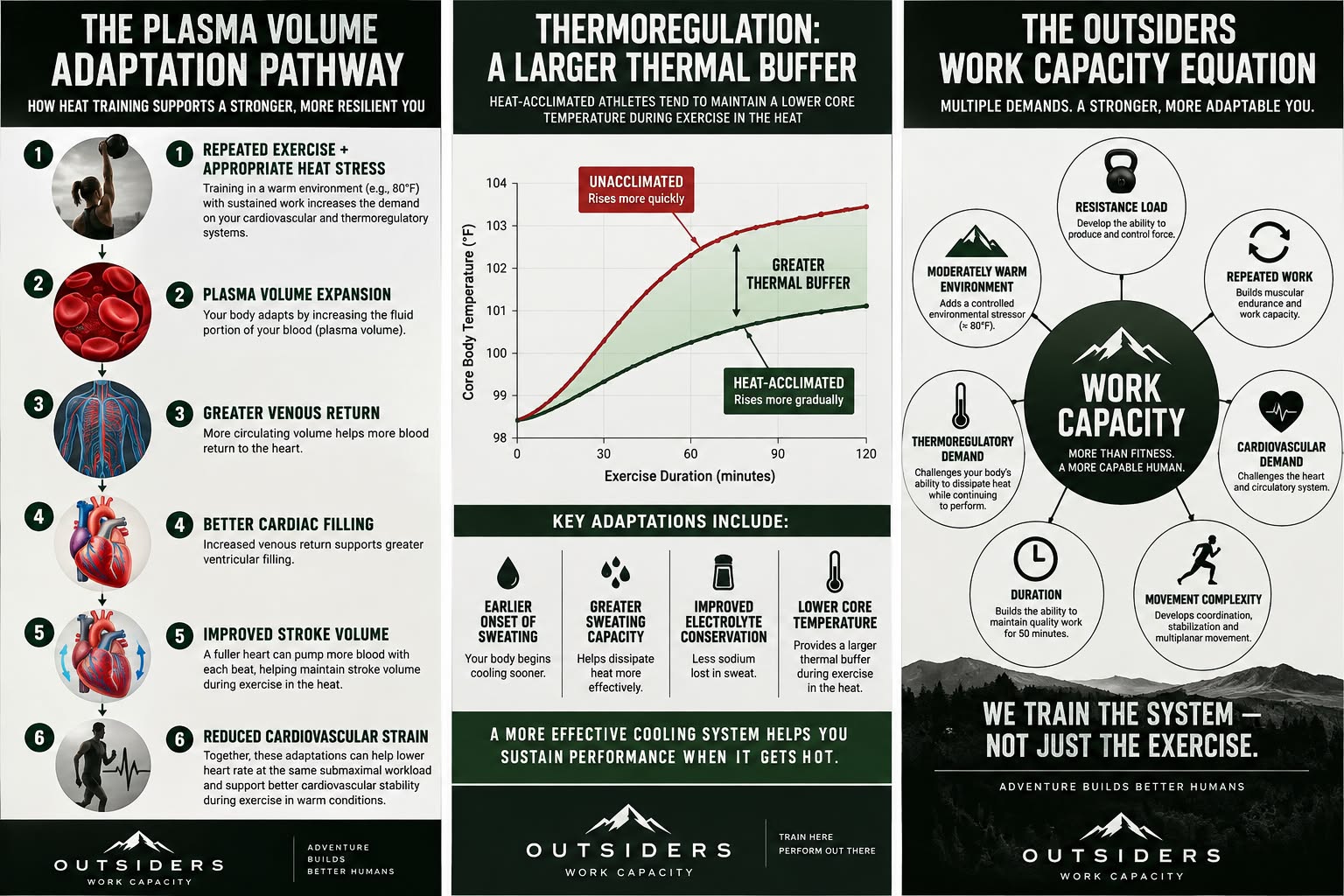
- Expanded plasma volume
- Improved maintenance of stroke volume
- Reduced cardiovascular strain during exercise in the heat
- Earlier onset of sweating
- Greater sweating capacity
- Improved conservation of electrolytes in sweat
- Improved skin blood-flow responses
- Better regulation of body temperature
- Potentially lower core temperature during subsequent exercise in the heat
- Improved thermal comfort and tolerance
- Improved capacity to sustain exercise in warm conditions
These changes help the body manage the competing demands of physical work and cooling more effectively.
PLASMA VOLUME: ONE OF THE MOST IMPORTANT ADAPTATIONS
One of the most interesting early adaptations associated with repeated exercise-heat exposure is an expansion of blood plasma volume.
Plasma is the fluid portion of your blood.
Red blood cells receive much of the attention because of their role in transporting oxygen, but plasma plays an essential role in maintaining blood volume and cardiovascular function.
Think of the cardiovascular system as a transportation network.
The heart is the pump.
Blood vessels are the roads.
Blood carries the cargo.
And plasma provides much of the circulating volume that allows the entire system to operate.
During prolonged exercise, particularly in warm conditions, sweating removes fluid from the body.
Without adequate replacement, circulating plasma volume can decrease.
At the same time, blood must be distributed to both working muscles and the skin.
This places additional demand on the cardiovascular system.
Repeated appropriate exercise-heat exposure can stimulate the body to expand its plasma volume.
And that can have important consequences.
MORE PLASMA CAN HELP THE HEART DO ITS JOB
Greater circulating blood volume can help increase venous return—the amount of blood returning to the heart.
More blood returning to the heart can improve ventricular filling.
That helps support stroke volume:
the amount of blood the heart pumps with each beat.
This creates an important relationship:
- Expanded plasma volume
This becomes particularly valuable during prolonged exercise.
As dehydration and heat stress increase, stroke volume can otherwise begin declining.
The body may compensate by increasing heart rate in an attempt to maintain cardiac output.
This contributes to what endurance athletes often experience as cardiovascular drift.
Heart rate gradually climbs even when the external workload hasn’t changed.
Heat acclimation and plasma-volume expansion can help reduce some of this cardiovascular strain.
IMPROVING THE BODY’S CARDIOVASCULAR RESPONSE TO HEAT
The warm environment creates an additional challenge for the cardiovascular system.
During exercise, working muscles require substantial blood flow.
At the same time, rising body temperature causes more blood to be directed toward the skin, where heat can be transferred away from the body’s core.
The cardiovascular system therefore has to accomplish several things simultaneously:
Supply working muscles.
Send blood toward the skin for cooling.
Maintain adequate blood pressure.
Manage fluid being lost through sweating.
Maintain cardiac output as exercise continues.
Repeated appropriate exposure to this challenge can produce important adaptations.
Plasma-volume expansion can increase the amount of blood available within the circulation.
Greater circulating volume can improve venous return and help maintain stroke volume.
Meanwhile, improvements in sweating and skin blood-flow responses can allow the body to dissipate heat more effectively.
Together, these adaptations can reduce the cardiovascular strain associated with exercising in warm conditions.
Following sufficient heat acclimation, an individual performing the same submaximal workload under comparable heat stress may demonstrate:
Lower cardiovascular strain
A lower exercise heart rate
More effective sweating
- Improved skin blood-flow responses
Better cardiovascular stability
Improved fluid and electrolyte conservation
Lower core temperature
The external workload may not have changed.
The body’s ability to manage that workload in the heat has.
YOUR COOLING SYSTEM CAN BECOME MORE EFFECTIVE
Plasma-volume expansion is only part of the story.
The body’s cooling mechanisms can adapt as well.
With sufficient repeated heat exposure, sweating can begin earlier during exercise.
That’s useful.
Instead of waiting until body temperature has risen as much before activating its cooling response, the body can begin dissipating heat sooner.
Sweat rate can also increase.
When environmental conditions allow sweat to evaporate effectively, greater sweating capacity can increase heat loss.
The composition of sweat can change as well.
With heat acclimation, the body can become better at conserving electrolytes—particularly sodium—rather than losing as much through sweat.
This doesn’t eliminate the need for appropriate hydration or electrolyte replacement during long or demanding exercise.
It simply means the body’s regulatory system can become better adapted to repeated heat exposure.
LOWER CORE TEMPERATURE: CREATING A LARGER THERMAL BUFFER
One particularly valuable adaptation associated with heat acclimation is a lower core temperature during subsequent exercise in the heat.
Think of this as creating a larger thermal buffer.
Imagine two athletes beginning the same prolonged workout under the same warm conditions.
One person’s core temperature rises relatively quickly.
The other’s rises more gradually because that athlete has developed more effective thermoregulatory responses.
The second athlete effectively has more room before excessive heat accumulation becomes a major physiological limitation.
That becomes increasingly important as exercise duration increases.
During a short workout, thermoregulation may never become a major limiting factor.
During several hours of hiking, running, climbing or racing, however, heat accumulation can become enormously important.
Improved thermoregulation can reduce physiological strain and support the ability to continue physical work in warm conditions.
THE HEART MAY NOT HAVE TO WORK AS HARD AT THE SAME SUBMAXIMAL WORKLOAD
Following sufficient heat acclimation, heart rate during the same submaximal exercise in the heat can decrease.
This doesn’t mean the exercise has suddenly become easy.
It means the cardiovascular system has become better adapted to the environmental challenge.
Expanded plasma volume helps maintain stroke volume.
Improved thermoregulation helps dissipate heat.
More effective sweating helps control body temperature.
Together, these adaptations can reduce the cardiovascular cost of performing the same amount of work in the heat.
In simple terms:
The body becomes better at managing the combined demands of exercise and temperature.
WHY COMBINE A WARM ENVIRONMENT WITH KETTLEBELLS AND SLEDGEHAMMERS?
This is where Outsiders Work Capacity training becomes particularly interesting.
We aren’t simply sitting in a warm room.
And we aren’t performing only steady-state cardio.
We’re moving external resistance repeatedly for approximately 50 minutes.
Kettlebells and sledgehammers allow us to combine:
- Strength
- Muscular endurance
- Cardiovascular conditioning
- Grip endurance
- Trunk stabilization
- Rotational control
- Coordination
- Power
- Multiplanar movement
- Work capacity
The moderately warm environment adds another variable:
Thermoregulatory demand.
The muscles are working.
The cardiovascular system is working.
The nervous system is coordinating movement.
The hands are maintaining grip.
The trunk is transferring and controlling force.
And simultaneously, the body is attempting to regulate its internal temperature.
That combination creates a very different training experience from traditional resistance training alone.
WORK CAPACITY IS MORE THAN CARDIO
Work capacity is sometimes confused with cardiovascular fitness.
They’re related, but they’re not identical.
Work capacity is your ability to repeatedly produce useful physical work while maintaining an acceptable level of movement quality.
That requires multiple systems working together.
Your cardiovascular system must support the effort.
Your muscles must continue producing force.
Your nervous system must maintain coordination.
Your trunk must continue controlling position.
Your grip must continue managing the implement.
Your thermoregulatory system must manage accumulating heat.
And your brain must continue making appropriate decisions as fatigue increases.
That’s why a kettlebell or sledgehammer Work Capacity session can be so different from simply spending 50 minutes on a cardio machine.
You’re not only sustaining movement.
You’re sustaining quality physical output under multiple simultaneous demands.
MOVEMENT QUALITY UNDER FATIGUE
Real life rarely asks us to perform under perfect laboratory conditions.
Neither does adventure.
On a mountain, fatigue accumulates.
Body temperature changes.
Heart rate increases.
Grip gets tired.
Postural muscles fatigue.
The climb continues.
The pack still needs to be carried.
The terrain still needs to be negotiated.
And we still need to move well.
That’s one reason Work Capacity training isn’t simply about accumulating repetitions.
It’s about maintaining movement quality as physiological demand increases.
The kettlebell or sledgehammer creates external resistance.
Repeated movement creates metabolic demand.
The 50-minute session creates duration.
The warm environment adds thermoregulatory demand.
And through all of it, your responsibilities remain the same:
Maintain position.
Maintain mechanics.
Control the load.
Control your breathing.
Continue producing quality work.
THERE MAY ALSO BE CELLULAR ADAPTATIONS
Heat exposure can also influence cellular stress responses, including proteins appropriately called heat-shock proteins.
Heat-shock proteins help cells respond to physiological stress and help protect and maintain proteins within the cell.
Exercise itself can stimulate these responses, and thermal stress can contribute additional signaling.
This is an active area of research, and we should be careful not to exaggerate what an approximately 80°F workout accomplishes at the cellular level.
But it demonstrates an important principle:
The body’s response to environmental stress occurs at multiple levels.
Adaptation isn’t confined to muscles.
It can involve cardiovascular regulation, fluid balance, thermoregulation, nervous-system responses and cellular signaling.
TRAINING YOUR PERCEPTION OF HEAT
There is another adaptation that’s harder to see on a fitness tracker:
How heat feels.
Repeated controlled exposure to exercise in warm environments can improve thermal tolerance and reduce perceived thermal strain.
The environment hasn’t necessarily changed.
Your physiological and perceptual response to that environment has.
For endurance athletes and adventurers, this matters.
Performance isn’t determined solely by strength, heart rate or muscular endurance.
The brain is constantly interpreting signals related to:
- Temperature
- Effort
- Fatigue
- Thirst
- Discomfort
- Movement
- Risk
One objective of training is learning how to respond appropriately to those signals.
That doesn’t mean ignoring them.
Quite the opposite.
We want people to become better at distinguishing between:
- Discomfort and danger.
- Fatigue and injury.
- Challenge and poor movement.
Being able to remain composed, breathe, maintain technique and make good decisions while appropriately uncomfortable is a valuable physical skill.
WHY THIS MATTERS FOR HIKERS AND ENDURANCE ATHLETES
For many Outsiders, training doesn’t end at the gym door.
We’re preparing for something.
A long hike.
A trail race.
A mountain.
An endurance event.
A backpacking trip.
An adventure.
And those environments aren’t climate controlled.
A cool morning can become a hot afternoon.
A shaded trail can become an exposed ridge.
A comfortable first hour can become a demanding eighth hour.
And as exercise continues, the body continues producing heat regardless of the outside temperature.
The ability to manage thermal stress therefore becomes another component of endurance preparation.
A moderately warm training environment can contribute to preparing the body for those situations.
But it is important to understand what it doesn’t replace.
It doesn’t replace endurance training.
It doesn’t replace strength training.
It doesn’t replace hydration planning.
And it doesn’t replace specific heat acclimatization when preparing for substantially hotter conditions.
It is another tool within a larger training system.
80°F IS A MODERATE STIMULUS—AND THAT’S INTENTIONAL
There is an important distinction between what we do and aggressive heat-acclimation protocols.
We’re training at approximately 80°F.
That can increase thermal demand during a vigorous 50-minute workout, but temperature alone doesn’t determine heat stress.
Humidity matters.
Airflow matters.
Clothing matters.
Exercise intensity matters.
Exercise duration matters.
Individual sweat rate matters.
Body size matters.
Fitness matters.
Previous heat exposure matters.
Metabolic heat production matters.
That’s why we don’t claim that simply entering an 80°F room automatically produces heat acclimation.
Instead, we use a moderately warm training environment as one additional component of Work Capacity training.
That’s an important distinction.
Because our goal isn’t to maximize heat.
Our goal is to create an appropriate training stimulus.
MORE HEAT IS NOT BETTER
This may be the most important principle in the entire discussion.
If 80°F provides an additional training stimulus, that doesn’t mean 90°F would automatically be better.
And if 90°F creates more stress, that certainly doesn’t mean 100°F would produce better results.
Training follows a fundamental principle:
Apply enough stress to stimulate adaptation without unnecessarily compromising safety, movement quality or recovery.
Once environmental heat significantly compromises technique, productive training, hydration or the athlete’s ability to regulate temperature safely, we’ve moved away from our objective.
We don’t train in warmth because suffering is productive.
We train in warmth because appropriate physiological stress can produce adaptation.
There is a major difference.
HYDRATION IS PART OF THE TRAINING

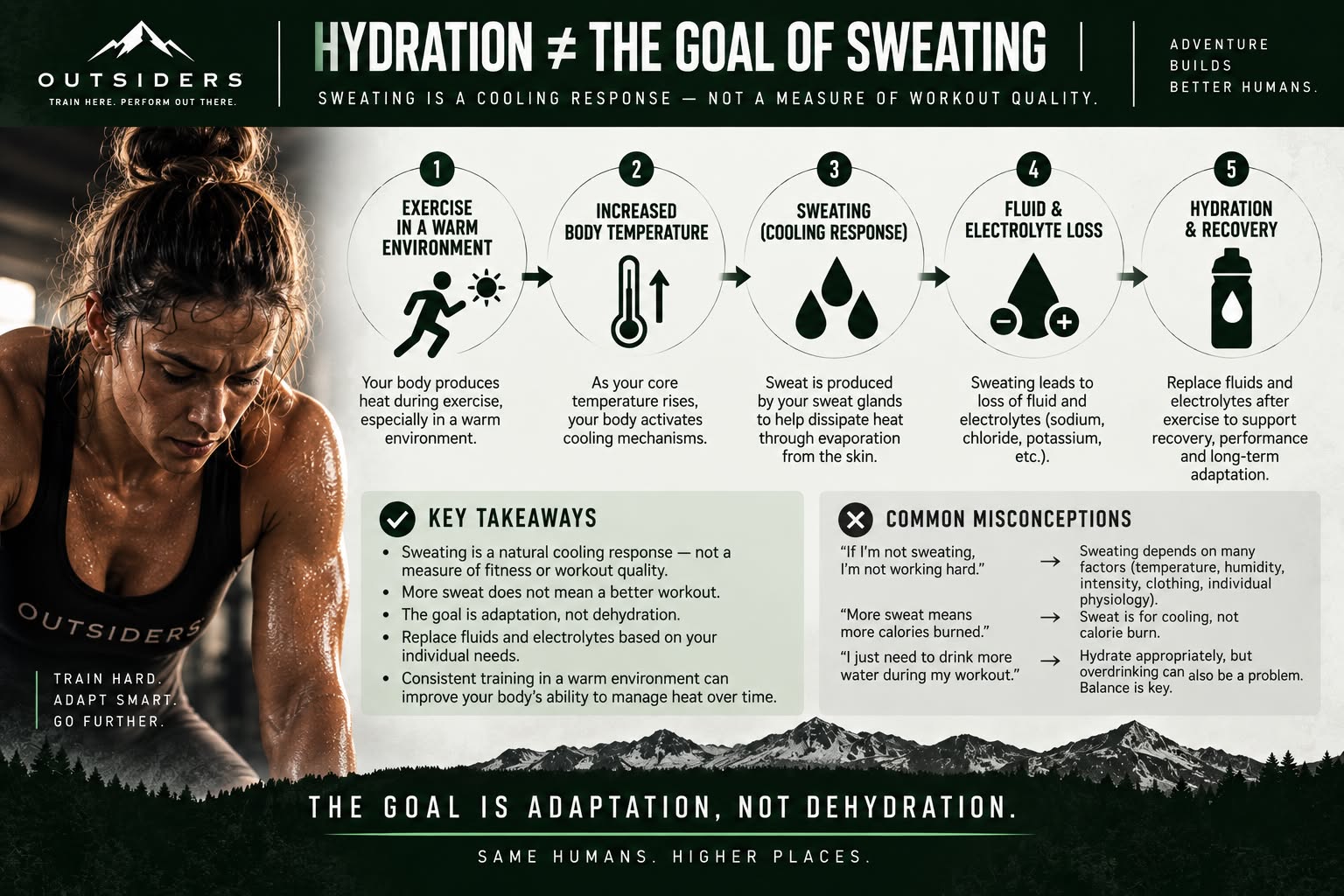
Sweating is not the goal of the workout.
It is the body’s response to thermal stress.
That distinction matters.
As sweating increases, fluid leaves the circulation.
Excessive dehydration can reduce plasma volume, increase cardiovascular strain and impair performance.
That’s the opposite of what we’re trying to accomplish.
Members should therefore arrive appropriately hydrated and replace fluids according to their individual needs.
Longer or particularly sweaty sessions may also require attention to electrolytes.
Individual responses vary enormously.
Some people sweat heavily.
Others don’t.
Some lose considerably more sodium.
Medications, health conditions, acclimatization and individual physiology can all affect heat tolerance.
There should never be a competition over who can tolerate the most heat.
The goal is adaptation—not suffering.

THE OUTSIDERS WORK CAPACITY EQUATION
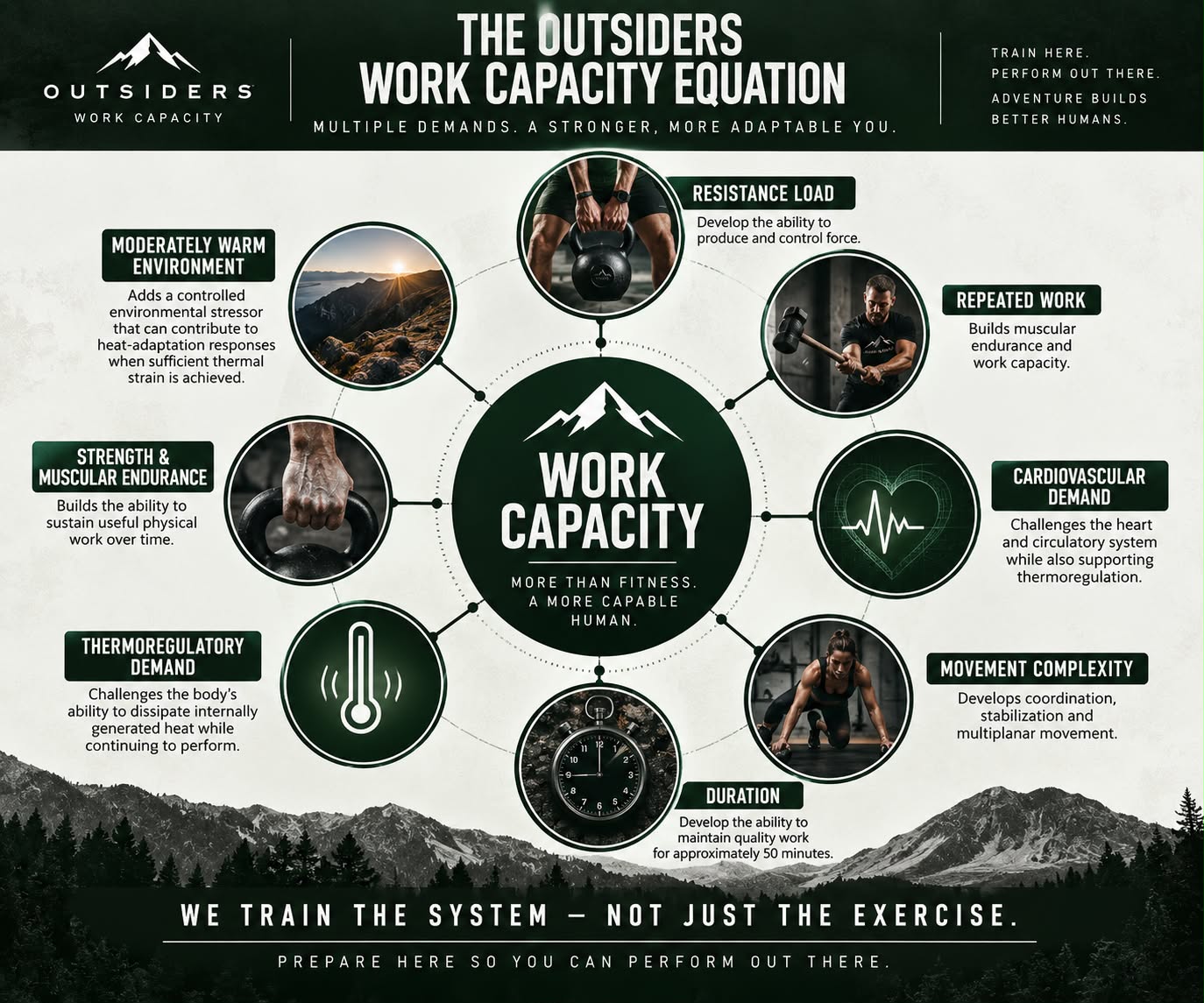
When we put everything together, our kettlebell and sledgehammer Work Capacity sessions provide several overlapping training stimuli:
RESISTANCE LOAD
Develop the ability to produce and control force.
REPEATED WORK
Develop muscular endurance and work capacity.
CARDIOVASCULAR DEMAND
Challenge the heart and circulatory system.
MOVEMENT COMPLEXITY
Develop coordination, stabilization and multiplanar movement.
DURATION
Develop the ability to maintain quality work for approximately 50 minutes.
THERMOREGULATORY DEMAND
Challenge the body’s ability to dissipate internally generated heat while continuing to perform.
MODERATELY WARM ENVIRONMENT
Add a controlled environmental stressor that may contribute to heat-adaptation responses when sufficient thermal strain is achieved.
None of these variables alone defines the program.
It’s their interaction that makes the training valuable.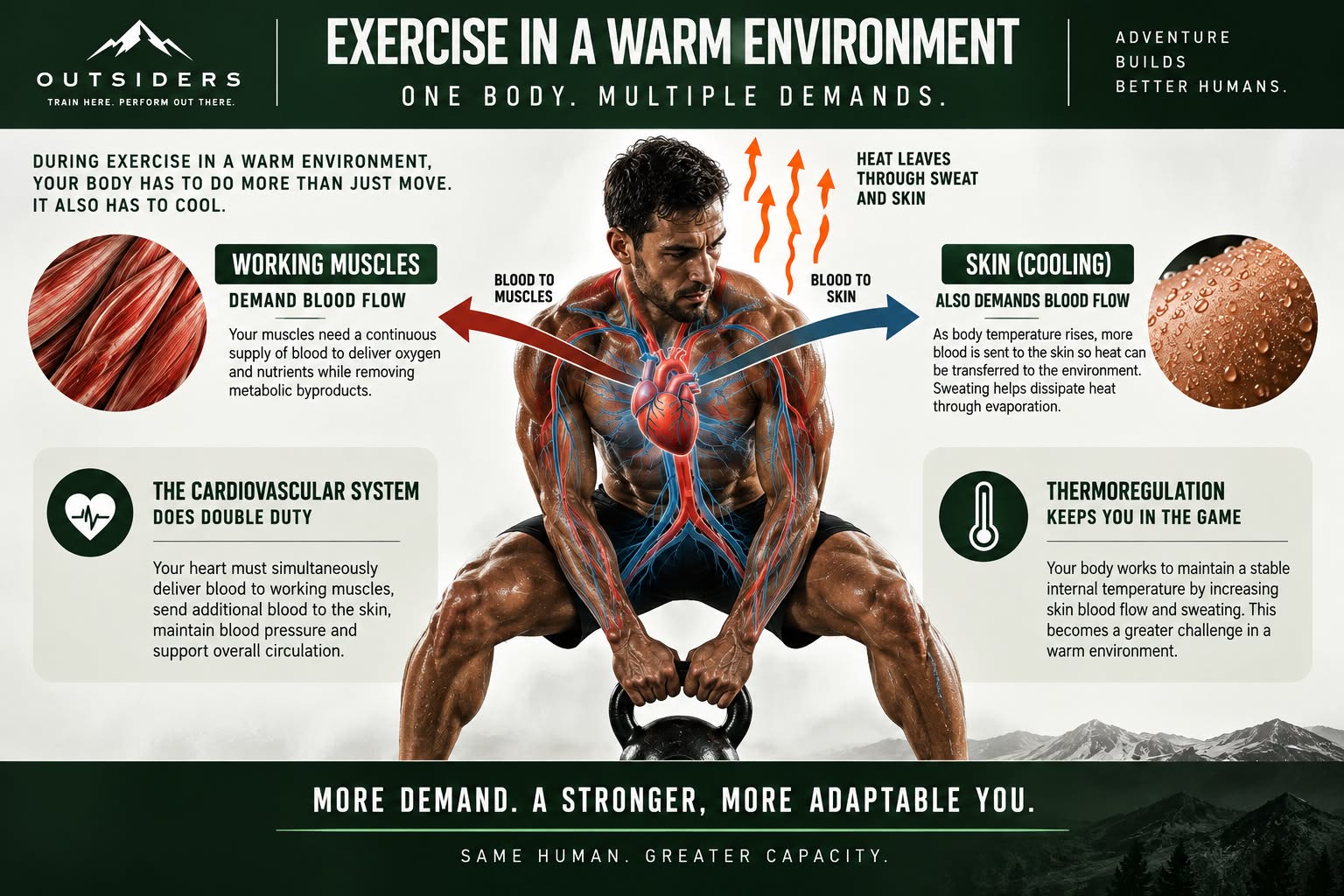
FROM THE GYM TO THE MOUNTAIN
Ultimately, fitness isn’t the destination.
It’s preparation.
Preparation for the hike.
The trail.
The mountain.
The race.
The expedition.
The adventure.
And those environments rarely cooperate with our plans.
Temperatures change.
Elevation changes.
Terrain changes.
Fatigue accumulates.
Heart rate drifts upward.
The pack feels heavier.
The climb gets longer.
The body gets warmer.
Eventually the question becomes:
Can you continue moving efficiently as the environment becomes less comfortable?
That’s one of the capacities we’re developing.
Not by creating reckless conditions.
Not by trying to destroy ourselves during a workout.
And not by believing that harder is always better.
We progressively expose the body to manageable challenges and give it an opportunity to adapt.
THE BIGGER LESSON: ADAPTATION
Ultimately, this is what training is.
Apply an appropriate stress.
Recover.
Adapt.
Repeat.
Resistance training tells the body:
Become stronger.
Aerobic training tells the body:
Become better at sustaining aerobic work.
Work Capacity training tells the body:
Become better at repeatedly producing useful physical work.
Training in a moderately warm environment adds another challenge:
Become better at managing heat while you work.
With sufficient and repeated thermal exposure, adaptations can include expanded plasma volume, improved maintenance of stroke volume, improved sweating and skin blood-flow responses, reduced cardiovascular strain, better thermal tolerance and potentially a lower core temperature during subsequent exercise in the heat.
But the purpose isn’t simply to become good at exercising in a warm room.
The purpose is to build a more adaptable human.
Because adventure doesn’t happen in climate-controlled conditions.
When the trail gets longer, the temperature rises, the climb continues and fatigue begins accumulating, we want the body to have encountered manageable physiological challenges before.
We train the system—not just the exercise.
We build capacity—not just fatigue.
We prepare here so we can perform out there.

RESEARCH & REFERENCES
WHAT THE RESEARCH SAYS
The physiological principles behind exercise-heat exposure and heat acclimation have been extensively studied in exercise physiology.
Repeated exercise in sufficiently warm environments can produce adaptations that improve the body’s ability to regulate temperature and maintain cardiovascular function during subsequent exercise in the heat.
Research has documented adaptations including:
Expansion of plasma volume
- Improved maintenance of stroke volume
Reduced cardiovascular strain
Reduced heart rate during a comparable submaximal workload in the heat
- Earlier onset of sweating
Increased sweating capacity
Reduced sodium concentration of sweat
- Improved skin blood-flow responses
Lower resting and exercising core temperatures under heat stress
- Improved thermal comfort and tolerance
Improved exercise capacity and performance in warm-to-hot environments
These adaptations do not occur simply because a room reaches a particular temperature.
The physiological stimulus is influenced by the interaction between:
- Environmental temperature
- Humidity
- Air movement
- Exercise intensity
- Exercise duration
- Clothing
- Metabolic heat production
- Hydration
- Individual physiology
- Previous heat exposure
For this reason, the approximately 80°F environment used during Outsiders kettlebell and sledgehammer Work Capacity sessions should be considered a moderately warm training environment rather than an extreme heat-acclimation protocol.
The purpose is not to maximize heat stress.
Instead, the warm environment provides an additional thermoregulatory challenge alongside approximately 50 minutes of resistance-based Work Capacity training.
When that environment creates sufficient thermal strain, repeated exposure may contribute to some of the physiological adaptations observed in the broader heat-acclimation literature.
The magnitude of those adaptations will vary between individuals.
KEY RESEARCH
Périard, Racinais & Sawka — Adaptations and Mechanisms of Human Heat Acclimation
Périard, J.D., Racinais, S., & Sawka, M.N. (2015). Adaptations and mechanisms of human heat acclimation: Applications for competitive athletes and sports. Scandinavian Journal of Medicine & Science in Sports, 25(S1), 20–38.
This comprehensive review describes many of the primary adaptations discussed in this article, including plasma-volume expansion, cardiovascular adaptations, improved sweating, improved skin blood flow, lower body temperatures and reduced physiological strain during exercise in the heat.
DOI: 10.1111/sms.12408
Tyler, Reeve, Hodges & Cheung — Heat Adaptation Meta-Analysis
Tyler, C.J., Reeve, T., Hodges, G.J., & Cheung, S.S. (2016). The Effects of Heat Adaptation on Physiology, Perception and Exercise Performance in the Heat: A Meta-Analysis. Sports Medicine, 46, 1699–1724.
This meta-analysis evaluated accumulated research examining heat adaptation rather than relying upon a single experiment.
It provides evidence that repeated heat exposure can produce measurable changes in physiological strain, thermal perception and exercise performance in the heat.
DOI: 10.1007/s40279-016-0538-5
Sawka, Leon, Montain & Sonna — Exercise and Heat Stress
Sawka, M.N., Leon, L.R., Montain, S.J., & Sonna, L.A. (2011). Integrated Physiological Mechanisms of Exercise Performance, Adaptation, and Maladaptation to Heat Stress. Comprehensive Physiology, 1(4), 1883–1928.
This extensive review explains why exercise in the heat places additional demands on the cardiovascular and thermoregulatory systems.
It also examines systemic heat-acclimation adaptations, cellular responses to heat, fluid and electrolyte balance and physiological mechanisms influencing exercise performance in hot environments.
DOI: 10.1002/cphy.c100082
Périard, Travers, Racinais & Sawka — Cardiovascular Adaptations
Périard, J.D., Travers, G.J.S., Racinais, S., & Sawka, M.N. (2016). Cardiovascular adaptations supporting human exercise-heat acclimation. Autonomic Neuroscience, 196, 52–62.
This review focuses specifically on cardiovascular adaptations produced by exercise-heat acclimation.
These mechanisms are particularly relevant to the Outsiders Work Capacity model because they help explain the relationships among heat exposure, circulating blood volume, stroke volume, cardiovascular strain and the body’s ability to maintain circulation while simultaneously dissipating heat.
DOI: 10.1016/j.autneu.2016.02.002
THE PHYSIOLOGICAL PICTURE
Taken together, the research gives us a useful model:
This is the physiological rationale behind incorporating a moderately warm environment into Outsiders Work Capacity training.
AN IMPORTANT DISTINCTION
The scientific literature should not be interpreted to mean:
“Exercising at exactly 80°F guarantees heat acclimation.”
It doesn’t.
Two rooms at 80°F can create very different physiological environments depending upon humidity and airflow.
Likewise, walking slowly for 20 minutes at 80°F creates a dramatically different metabolic and thermal challenge than performing a vigorous 50-minute kettlebell or sledgehammer Work Capacity session at the same temperature.
The actual stimulus comes from the interaction between:
At Outsiders, approximately 80°F provides a moderately warm environmental layer on top of an already demanding Work Capacity session.
We aren’t trying to reproduce an extreme laboratory heat-acclimation protocol.
We’re applying the underlying principle conservatively:
Create an appropriate challenge.
Allow the body to adapt.
Maintain movement quality.
Manage hydration.
Never confuse greater suffering with better training.
That remains consistent with the larger Outsiders philosophy:
MECHANICS BEFORE INTENSITY.
POSITION BEFORE MOVEMENT.
ADAPTATION—NOT EXHAUSTION—IS THE GOAL.
Stay connected with news and updates!
Join our mailing list to receive the latest news and updates from our team. Don't worry, your information will not be shared.
We hate SPAM. We will never sell your information, for any reason.
